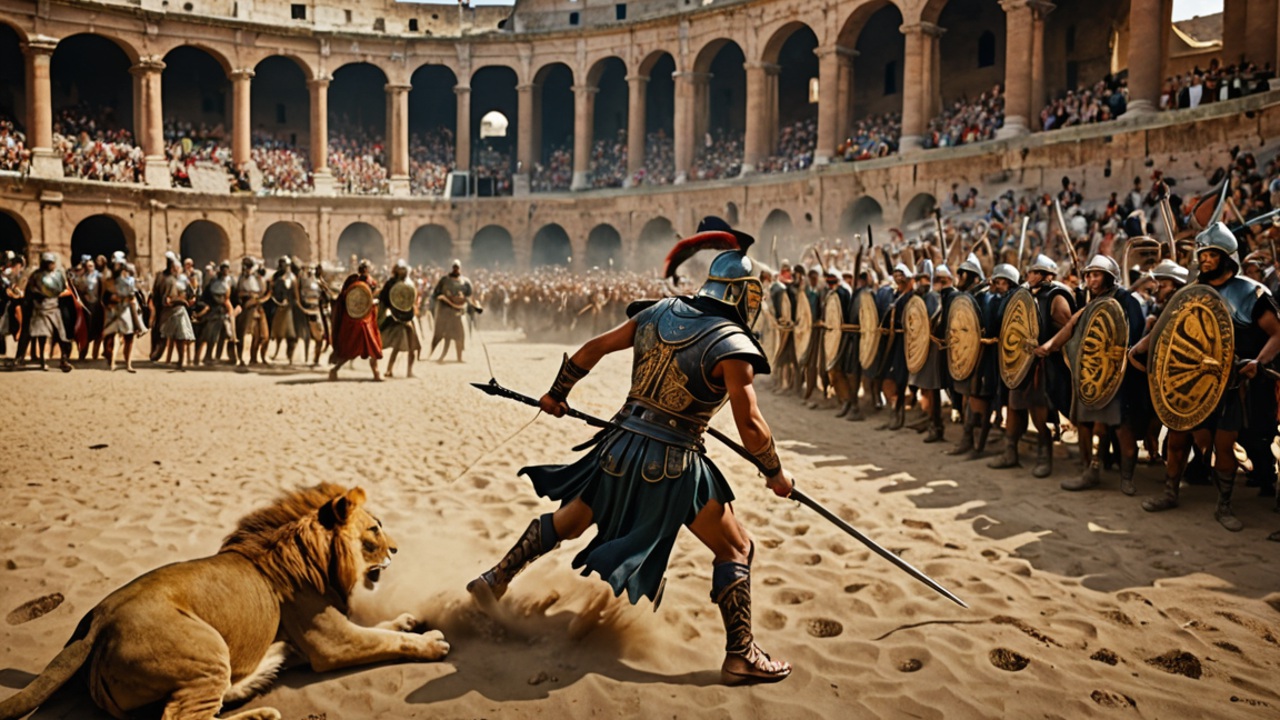
⚔️ Gladiators: Separating Hollywood Fiction from Archaeological Fact
I have walked among the gladiator barracks in Pompeii, visited their cemeteries in Ephesus, and read the inscriptions still speaking from the stone. And every time I do, I become more convinced: almost everything Hollywood taught us about gladiators is wrong.
We were led to believe they were doomed slaves condemned to death, but the reality—the one visible in the bones, the contracts, and the graffiti—tells a different story. They were athletes, celebrities, and part of an economic machine far more sophisticated than we usually imagine.
The Biggest Lie: They Weren’t All Slaves
The first thing I discovered, which often surprises people when I share it, is that many gladiators were not forced to fight—they chose it. Professor Michael Carter, in his study published in the Journal of Roman Studies (2003), demonstrated that nearly half of all gladiators during the Imperial period were auctorati. These were free men who volunteered.
Why would anyone sign up for such a profession? The contract, the auctoramentum, explains it. In exchange for signing, they received a bounty of two thousand sesterces, double the average annual salary. They were guaranteed food, housing, and medical attention. If they survived between three and five years, they could achieve fame and wealth. Contracts found in Pompeii mention prizes of up to twelve thousand sesterces for veterans.
One of the most famous cases was Marcus Attilius, a free man who volunteered, won his first fight against a veteran with fourteen victories, and became a local star. His name is repeated on the walls of Pompeii, painted by admiring fans who idolized him.
The Economics of Death (That Wasn’t Actually Death)
Another major surprise: gladiators rarely died in combat. Professor Kathleen Coleman of Harvard analyzed epitaphs and combat records and found that in the 1st century, the mortality rate was only around 10%, rising to 15% in the 2nd century, and about 25% by the 3rd century. This is far lower than anyone imagines.
The reason was entirely economic. Training a gladiator cost nearly 100,000 sesterces, which was the same cost as ten slaves or a century of rent. The lanistae, or owners of the schools, were not running butcher shops; they were managing investments. Death was not profitable. The physician Galen, who worked at the gladiator school in Pergamum between 157 and 161 AD, left records of sixty gladiators he treated: only five died, and three of those were due to training accidents, not combat. All of this proves that behind the spectacle lay strategy, calculation, and care.
The Fighters Were Specialists, Not Brawlers
Every type of gladiator was a specialist with their own distinct style, almost a character archetype. The murmillos, sometimes called “fish fighters,” wore armor weighing fifteen kilograms, carried a rectangular shield, and had a fish-shaped crest on their helmets. Their natural rivals were the thraeces, who used a small shield and a curved sword, the sica. The secutores, with their smooth, closed helmets, were designed to fight the swift retiarii, the gladiators who used a trident and net. The retiarii were the most vulnerable, but often the most popular.
Every matchup was carefully designed to balance strength, speed, and spectacle. Rome didn’t invent sport; it invented the staging of sport.
Training Revealed by Bones
Forensic analysis of skeletons found in Ephesus, performed by Fabian Kanz and published in Forensic Science International (2007), revealed that gladiator bones were 20% denser than those of the average citizen. The muscle insertions showed repetitive, disciplined sword training. Their diets, rich in barley and calcium, left unmistakable chemical traces. And many bones showed healed fractures—evidence of medical attention and rehabilitation. They were professional athletes, and their bodies were their tools.
Voices from Pompeii and the Women of the Arena
In Pompeii, graffiti preserved by the eruption of Vesuvius brings us closer to the actual voice of the gladiators and their fans. One reads: “Celadus, the glory of the girls, the heart of the girls” (CIL IV 4397). Another proclaims: “Crescens the net fighter, heart-throb of women” (CIL IV 4345). These are the phrases of fans, of admirers who idolized these men. They speak of fame, pride, and desire. They were the celebrity idols of their day.
It is also historically confirmed that women gladiators, the gladiatrices, existed. A relief from Halicarnassus clearly shows two women named Amazon and Achillia fighting in the arena. Juvenal described noble women who trained with weapons in his Satires. The existence of these female fighters was so disruptive to Roman social order that in 200 AD, Septimius Severus officially banned free women from participating in the games.
The Rules Nobody Talks About
Far from the Hollywood image of bloody chaos, gladiatorial combat was a spectacle governed by clear rules. There were always two referees, the summa rudis and the secunda rudis, who could stop the fight, adjust the equipment, or even declare a draw. Fights could end with missio (the defeated was spared) or sine missione (death), which was usually reserved for special occasions.
And as for the famous “thumbs down”? There is no single ancient source that confirms it. The phrase pollice verso only means “thumb turned.” We do not know for sure what gesture actually indicated death.
The End of an Era
The end of the games was not sudden; they slowly faded out. In 325 AD, Constantine discouraged them but did not ban them. In 399, Honorius closed the schools. The final games in Rome were held in 404. It wasn’t morality that killed them, but economics. Training and maintaining gladiators simply became an impossible luxury for a crumbling empire.
Studying gladiators is not about studying violence; it is about studying humanity. They understood the power of specialized training, audience psychology, the need for rules, and the economics behind entertainment. They knew that raw violence doesn’t sell, but spectacle does.
Every time I stand in the center of the amphitheater, I don’t see a site of death. I see discipline, ambition, and the seed of everything we now call sport, celebrity, and spectacle. Gladiators were not merely victims or beasts. They were professionals of risk, pioneers of entertainment, and protagonists of the most human and contradictory side of Rome. Gladiators didn’t just fight for life—they performed it. And maybe that’s why, two thousand years later, we still can’t look away.