Underground Colosseum Tours: Is the Hypogeum Worth the Extra Cost?
Standing in the Colosseum is incredible. But walking beneath it — through the same tunnels where gladiators waited in darkness, hearing the roar of 50,000 Romans above them — that’s something else entirely.
The Colosseum Underground, or hypogeum, is one of the most exclusive experiences you can have in Rome. But with tickets starting at €63 and going up to €160, you’re paying roughly 3-4 times more than a standard admission. The big question: is it actually worth it?
I’m going to break down exactly what you see, what you pay, and whether that extra cost delivers value — or just bragging rights.
What Exactly Is the Hypogeum?
The word “hypogeum” comes from Greek and literally means “underground.” In the context of the Colosseum, it refers to the two-level maze of tunnels, chambers, and passages that sit directly beneath the arena floor.
Here’s what most people don’t know: the hypogeum wasn’t part of the original design.
When Emperor Vespasian started building the Colosseum in 72 AD and his son Titus inaugurated it in 80 AD, the arena floor could actually be flooded for mock naval battles (naumachiae). The space below was open.
It was Emperor Domitian — Titus’s younger brother — who added the underground around 90 AD. This addition transformed how the games were staged, making dramatic entrances and surprise appearances possible through an elaborate system of trapdoors and elevators.
The Engineering Marvel
The hypogeum was an operational masterpiece:
- 80 vertical shafts connected the underground to the arena above
- 36 trapdoors allowed animals and gladiators to appear suddenly in the arena
- Manual elevators (called “hegmata”) could lift up to 300 kg using a system of winches, ropes, and counterweights
- Underground tunnels connected to the Ludus Magnus (the largest gladiator training school) and nearby animal stables
- Private passages for the Emperor and Vestal Virgins to enter without facing crowds
Teams of slaves operated this machinery, working in complete coordination to pull off the spectacles that entertained imperial Rome. Animals like lions, tigers, elephants, and crocodiles were held in cages, while gladiators waited in holding cells before their dramatic arena entrances.
The engineering was so sophisticated that scenery could be changed between acts, animals could emerge through trap doors as if by magic, and entire forest recreations (complete with real trees) could be assembled for hunting displays.
What You Actually See on an Underground Tour
When you book a Colosseum Underground tour, here’s what you’re getting access to:
1. The Hypogeum Tunnels 🔦
You descend into the two-level underground network. The experience is atmospheric — narrow corridors with massive travertine blocks, dim lighting that makes you feel the weight of history.
You’ll see:
- Original gladiator holding cells
- Animal cages where exotic beasts waited
- Reconstructions of the ancient elevator system
- Remnants of the drainage system
- Evidence of the pulley mechanisms that made the lifts work
- Archaeological digs still in progress
Your guide will explain how the machinery worked, share stories about what gladiators experienced down here, and help you visualize the chaos of game day when this underground hub was buzzing with activity.
2. The Arena Floor 🏟️
After exploring below, you emerge onto the reconstructed arena floor — the actual fighting surface where gladiators battled.
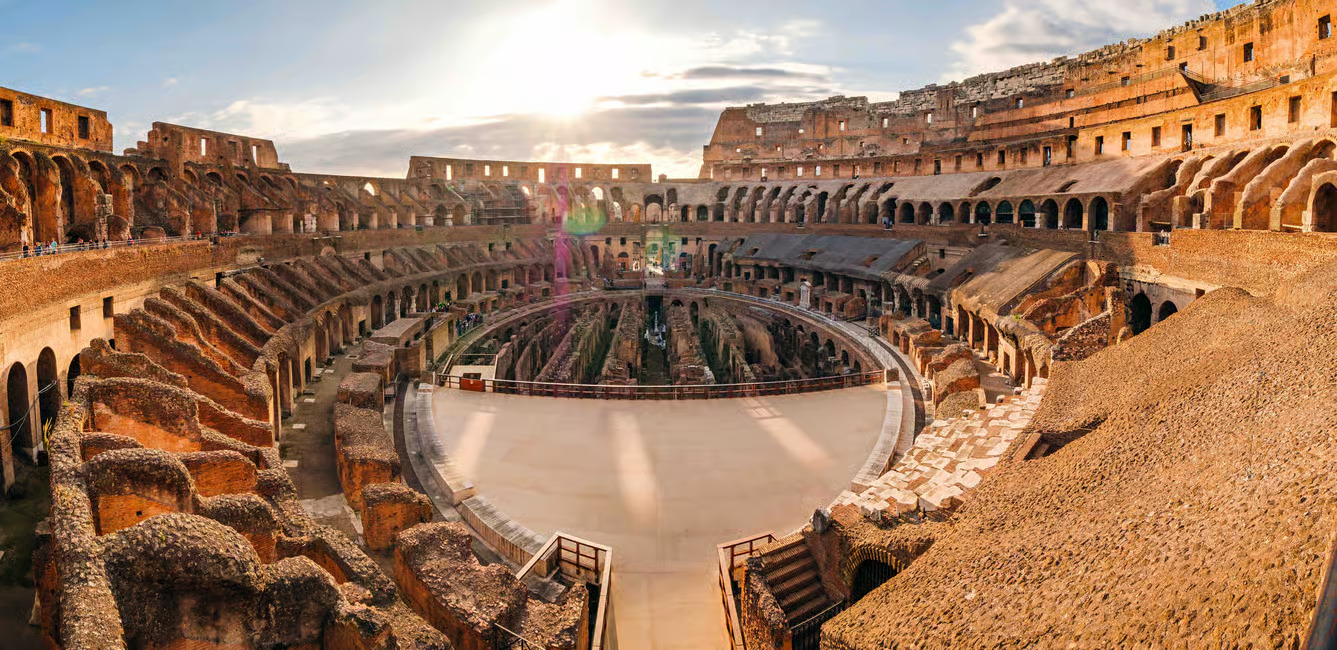
Standing here gives you the gladiator’s perspective: looking up at where 50,000-80,000 Romans once screamed and cheered. You can peer down through the open sections of the floor to see the hypogeum from above, understanding how the trap doors and elevators connected the two spaces.
The arena floor is included in most underground tours, so you’re getting both perspectives in one experience.
3. Standard Colosseum Access 🏛️
Your tour continues through the first and second tiers of the Colosseum (the same areas accessible with a standard ticket), where you’ll learn about the social hierarchy of seating, the architectural innovations, and the history of the games.
4. Roman Forum & Palatine Hill 🌳
Most underground tours include access to these sites as well. The Roman Forum was the center of ancient Rome’s political life, while Palatine Hill was home to emperors’ palaces and offers stunning panoramic views.
Total tour time: 2.5-3 hours for the full experience.
The Real Costs: Breaking Down Your Options
Underground access isn’t cheap, but let’s look at what different tour types actually cost and what you get:
Budget Option: Standard Ticket (€18-24)
What you get:
- First and second tiers of the Colosseum
- Roman Forum
- Palatine Hill
- NO arena floor
- NO underground
What you miss: The exclusive areas. You’ll see the hypogeum from above through the gaps in the reconstructed floor, but you can’t walk through it.
Mid-Range: Standard Underground Tour (€63-89)
What you get:
- Hypogeum access with guided tour
- Arena floor
- First and second tiers
- Roman Forum & Palatine Hill
- Skip-the-line entry
- Licensed guide
- Audio devices for larger groups
Group size: Usually 20-25 people
Tour examples:
- Basic underground + forum combo: ~€63
- Standard full ancient Rome tour: €89
Premium: Small Group Tours (€119-160)
What you get:
- Everything from standard tours
- Smaller group (6-15 people max)
- More personalized attention from guide
- Better photo opportunities
- Often includes extra perks
Worth it if: You value intimate experiences and hate crowded tours.
VIP: Night Tours (€74-109)
What you get:
- Underground access after closing hours
- Dramatically lit Colosseum
- Fewer crowds
- Unique atmosphere
- Usually 75-90 minutes focused on Colosseum only
Worth it if: You want the most atmospheric experience possible.
Note: Evening tours typically don’t include Roman Forum/Palatine Hill since those close earlier.
The Honest Pros and Cons
Let me give you the unfiltered truth based on thousands of visitor reviews and my own analysis:
✅ Why the Underground Tour IS Worth It
1. It’s the Only Way to Access the Hypogeum
This is huge. Standard tickets don’t get you down there. It’s restricted access, and only about 2% of Colosseum visitors ever see the underground. If you want this experience, you must book a tour.
2. The Historical Context Is Incredible
Seeing where gladiators actually prepared for battle, where animals paced in cages, and understanding the mechanical systems brings the entire Colosseum to life in a way that standing in the seating tiers never will.
One reviewer put it perfectly: “Walking through the hypogeum, I learned about the trap doors, pulley systems, and tunnels that once held wild animals before launching them into the arena. It was surreal to stand where they once stood, imagining the roar of 50,000 spectators above.”
3. Skip-the-Line Access
Underground tours include priority entry. During summer, this can save you 30-60 minutes of standing in brutal Roman heat.
4. Expert Guides Make the Difference
A standard ticket gets you into the Colosseum but doesn’t tell you the stories. Guides explain:
- How the elevators worked
- Why gladiators sometimes fought in complete darkness (training technique)
- How animals were transported through the tunnel network
- The role of the Sanitarium (field hospital) where gladiators were patched up
Reviews consistently praise guides’ knowledge: “Our guide was an archaeologist who explained every detail. Her background made it even better.”
5. Small Group Experience
Unlike the general entrance where thousands shuffle through daily, underground tours have limited capacity. You’re not fighting crowds for views or struggling to hear your guide.
6. The Arena Floor Perspective
Standing where gladiators fought — looking up at the tiers where crowds decided their fate — is visceral and emotional. You can’t get this with a standard ticket.
❌ Why You Might Skip the Underground Tour
1. The Cost Premium Is Significant
You’re paying €45-142 more than a standard ticket. For budget travelers or families, that adds up fast.
2. Limited Availability = Booking Stress
Underground tours sell out 4-8 weeks in advance during peak season. If you’re planning last-minute, you might not get in.
3. Physical Limitations
The underground involves:
- Uneven ancient floors
- Narrow passageways
- Stairs
- No elevator access
Not recommended for: Wheelchairs, strollers, significant mobility issues, claustrophobia.
4. You Can See (Some of) It From Above
With a standard ticket, you can peer down through the reconstructed arena floor gaps and see parts of the hypogeum. It’s not the same as walking through it, but you do get a view.
5. Alternative Underground Experiences Exist
One tour company (Italian Art Ventures) makes an interesting argument: if you want a true underground experience, the Basilica of San Clemente offers a more immersive descent through actual layers of history (12th-century church → 4th-century church → 1st-century Roman buildings) for less money.
The Colosseum hypogeum is technically “underground” but you can see it from the arena floor above, so it’s not truly subterranean in the way San Clemente is.
What Visitors Actually Say: Real Reviews
I pulled feedback from thousands of tours to see what people really thought:
The Positive (Majority Opinion)
⭐⭐⭐⭐⭐ “The underground tour was the best decision I made. Walking through the hypogeum, I almost heard the air resonate with fierce battle cries and animal growls. The ancient elevator reconstruction was mind-blowing.”
⭐⭐⭐⭐⭐ “Worth every penny. Our guide brought the Colosseum to life with stories I never would have known. The underground felt intimate and VIP.”
⭐⭐⭐⭐⭐ “Skip-the-line access alone was worth it in 40°C heat. Then seeing where gladiators waited before battle? Unforgettable.”
The Critical (Minority Opinion)
⭐⭐⭐ “Interesting but overhyped. You can see most of the underground from the arena floor anyway. Not sure it justified the extra €70 for my family of four.”
⭐⭐⭐ “Guide rushed us through. For the price, I expected more time in the underground sections.”
Overall consensus: Most visitors (80%+) say it’s worth it, especially first-time Rome visitors and history enthusiasts. Budget travelers and repeat visitors are more mixed.
Underground Tour vs. Arena Floor Tour: Which Should You Choose?
If you can only afford one upgrade, here’s how they compare:
Arena Floor Only Tours (€45-70)
You get:
- Stand on the reconstructed arena
- Look down at the hypogeum through floor gaps
- Enter through the Gladiator’s Gate (Porta Libitinaria)
- Skip-the-line access
- Guided tour of standard Colosseum areas
Best for:
- Tighter budgets
- People who want the “gladiator moment” without maximum cost
- Visitors who don’t mind seeing the underground from above
Underground + Arena Combo (€63-160)
You get:
- Everything from arena-only tours
- PLUS: Walk through the hypogeum tunnels
- PLUS: See animal cages, elevator systems, gladiator cells up close
Best for:
- History buffs
- First-time visitors who want the full experience
- Photography enthusiasts (darker, more atmospheric shots)
- Anyone fascinated by ancient engineering
My take: If you’re already spending €45 on an arena tour, the extra €20-40 for underground access is worth it. You’re 95% of the way there already.
Alternatives If Underground Tours Are Sold Out
Don’t panic if you can’t snag underground tickets. Here are solid backup plans:
1. Arena Floor Tour
Still exclusive, still includes skip-the-line, and you get a great view of the hypogeum from above. You’re missing the walk-through but saving €20-30.
2. Standard Guided Tour
A good guide can bring the Colosseum to life even from the standard access areas. You’ll learn the same history and stories for €30-45.
3. Night Tour (Without Underground)
If you can’t get underground access but want something special, night tours offer dramatic lighting and atmosphere for around €40-50.
4. Book WAY in Advance
Seriously — 60+ days ahead during May-September. Underground tickets are released, and the bots and resellers grab them instantly. Set calendar reminders for exactly 30 days before your visit date.
Tips for Booking Your Underground Tour
When to Book
Minimum: 4 weeks ahead
Recommended: 6-8 weeks ahead for summer (May-September)
Best practice: As soon as you know your Rome dates
Where to Book
Trusted platforms:
- GetYourGuide (4.7/5 stars, 4,500+ reviews for underground tours)
- Viator
- The Roman Guy
- Walks Inside Rome
Official site: ticketing.colosseo.it offers the €24 bundle with underground access, but good luck beating the bots (see my other guide on that nightmare).
What to Bring
✅ Valid government-issued photo ID (required for entry)
✅ Comfortable, sturdy walking shoes (no flip-flops)
✅ Water bottle (refillable at Rome’s public fountains)
✅ Small backpack or bag (large bags not permitted)
✅ Hat and sunscreen for summer
✅ Light jacket for underground (cooler down there)
What to Avoid
❌ Large bags or luggage
❌ Glass bottles
❌ Sharp objects
❌ Expecting wheelchair accessibility underground
❌ Arriving less than 30 minutes before your tour time
The Verdict: Is the Colosseum Underground Worth It?
Yes, IF:
- ✅ You’re visiting Rome for the first time
- ✅ You’re a history enthusiast or engineering nerd
- ✅ You have the budget (extra €45-70 per person)
- ✅ You book far enough in advance to secure tickets
- ✅ You don’t have mobility issues
Skip it IF:
- ❌ You’re on a tight budget and need to prioritize
- ❌ You have mobility limitations (wheelchair, walker, etc.)
- ❌ You’re a repeat visitor who’s already done the underground
- ❌ You prefer spending on experiences like Vatican tours or food
- ❌ You’re satisfied seeing the hypogeum from above (arena floor view)
My personal take: For first-time visitors who can afford it, the underground tour is worth the splurge. The combination of exclusive access, skip-the-line convenience, expert guiding, and the visceral experience of walking where gladiators once walked justifies the cost.
But if you’re traveling with a family of four, the math changes. That’s €280-400 for underground access vs. €72-96 for arena floor tours. In that case, arena floor tours + a great gelato afterward might be the smarter play.
Frequently Asked Questions
Can I visit the underground without a tour?
No. The hypogeum is a restricted area only accessible through licensed guided tours. Standard tickets don’t include it.
How long does the underground tour last?
Typically 2.5-3 hours total, with about 30-45 minutes spent in the underground sections specifically.
Are underground tours available year-round?
Yes, though night tours with underground access may have seasonal variations.
Is there an age minimum for underground tours?
Most tours require children to be at least 6-7 years old due to the nature of the underground environment and content.
Can I take photos in the underground?
Yes, photography is generally allowed. Flash photography may be restricted in certain areas.
What if I’m claustrophobic?
The tunnels are narrow and can feel confining. If you have severe claustrophobia, consider an arena floor tour instead where you can see the hypogeum from above.
Do underground tours include the third tier?
No, you can’t access both underground AND third tier (belvedere) on the same ticket. These are separate special access options.
What’s the best time of day for an underground tour?
Morning tours (8:30-10:00 AM) are cooler and less crowded. Late afternoon tours (after 4:00 PM) offer better lighting for photos.
Is the underground tour suitable for children?
Kids interested in history will love it. However, younger children may find the 2.5-3 hour tour too long, and the darker, confined spaces can be intimidating.
Final Thoughts
The Colosseum underground isn’t just about seeing more of the monument — it’s about understanding how the greatest entertainment venue in the ancient world actually worked. It’s the difference between watching a magic show and learning how the illusions are created.
When you stand in the hypogeum, surrounded by travertine blocks that are 1,900+ years old, you’re not just observing history. You’re standing in the exact spot where men prepared to risk their lives for glory, where exotic animals paced in cages thousands of miles from home, and where Roman ingenuity created theatrical magic that entertained emperors.
Is that worth an extra €50-70? For me, absolutely. For your budget and travel style, only you can decide.
But if you do book it, you won’t be wondering “what if?” as you leave Rome. And that’s worth something too.
Mario Dalo is a Rome tourism expert who helps travelers plan their Colosseum visits.