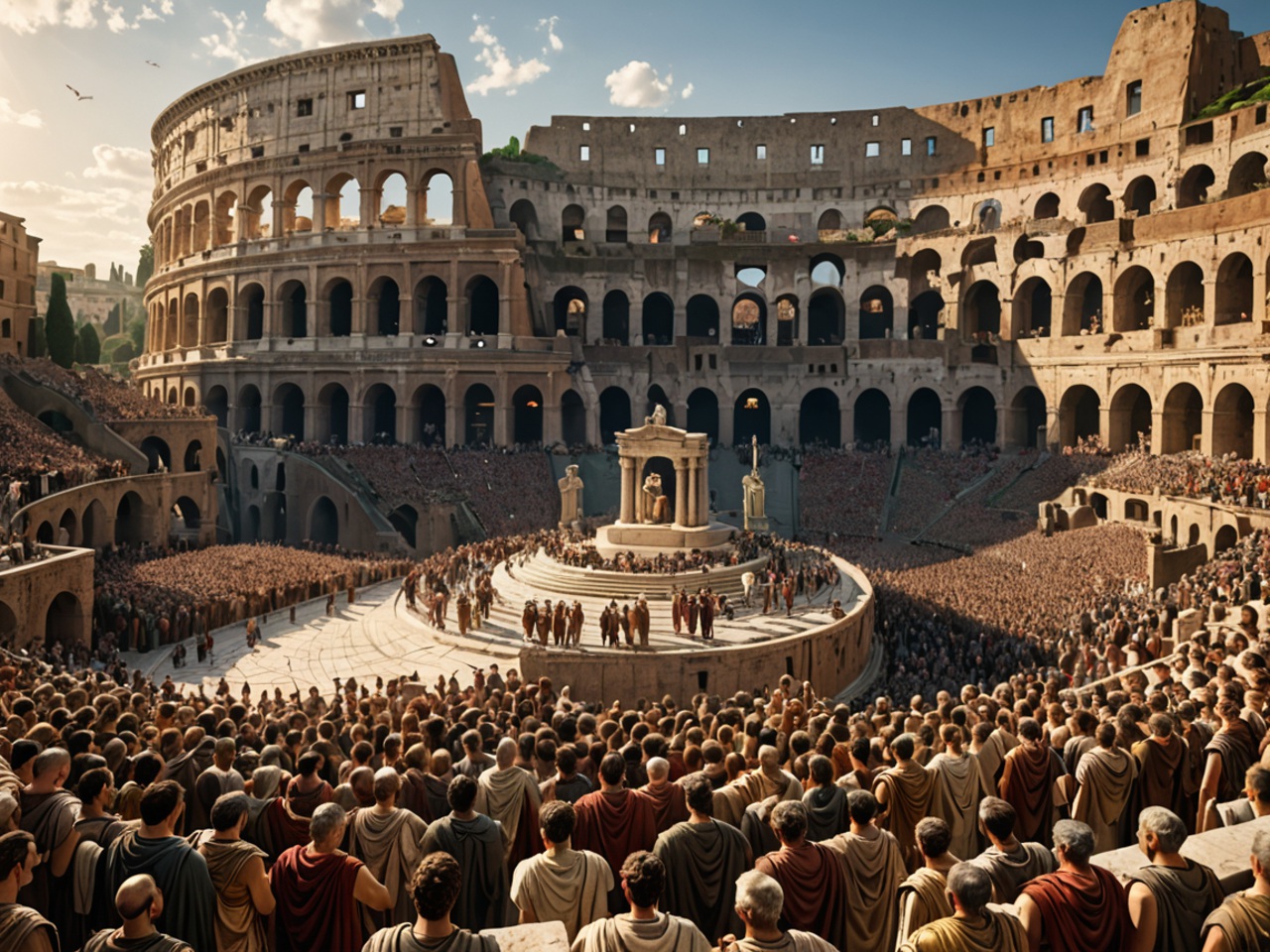
ColossThe Architecture of the Colosseum: How Romans Built the Impossibleeum Architecture
The Colosseum isn’t just big – it’s an architectural revolution frozen in stone. After researching the engineering behind this monument, I’ve discovered that Romans solved problems that challenged architects until the 20th century. Here’s how they built something that shouldn’t exist.
The Foundation: Building on a Lake
The most astounding architectural feat happens where nobody sees it. Vespasian chose to build on Nero’s drained artificial lake – essentially a swamp. The solution was audacious:
The Ring Foundation:
- Depth: 12-13 meters
- Width: 31 meters
- Material: 500,000 tons of concrete
- Shape: Elliptical ring (not solid platform)
According to archaeological investigations by Lancaster and Ulrich (2014), this foundation acts like a massive doughnut, distributing weight evenly on unstable ground. Modern engineers attempting similar projects on soft soil still reference this technique.
The Elliptical Genius
The Colosseum isn’t round – it’s a perfect ellipse:
- Major axis: 189 meters
- Minor axis: 156 meters
- Ratio: 1.21 (nearly the golden ratio)
Why elliptical? Professor Rabun Taylor’s geometric analysis reveals multiple advantages:
- 15% more seating than circular design
- Better sightlines from every angle
- Structural stability against lateral forces
- Optimal acoustics for 50,000 people
The precision is staggering – deviation from perfect ellipse: less than 30cm over entire perimeter.
The Revolutionary Arch System
The Statistics That Shouldn’t Work
The Colosseum contains:
- 240 arches on lower three floors
- 80 arches per floor, each numbered
- Each arch supporting 500 tons
- Zero steel reinforcement
The secret? Romans perfected the “arch action” – compression forces traveling through voussoirs (wedge stones) to foundations. Research by the MIT Masonry Group shows these arches actually get stronger under load, not weaker.
The Triple Architecture Order
Each level uses different classical orders:
- Ground Floor: Tuscan (simplified Doric) – strongest, plainest
- Second Floor: Ionic – more decorative scrolls
- Third Floor: Corinthian – most ornate capitals
This wasn’t just aesthetics. The visual lightening upward counters the psychological weight of the massive structure – a technique copied in every major public building since.
Concrete: The Roman Revolution
Roman concrete (opus caementicium) was fundamentally different from modern concrete:
The Magic Ingredient: Volcanic ash (pozzolana) from Campi Flegrei near Naples
- Creates calcium-aluminum-silicate-hydrate bonds
- Self-healing: cracks trigger lime recrystallization
- Gets stronger over time (modern concrete weakens)
Analysis by Jackson et al. in American Mineralogist (2017) revealed Roman concrete contains rare aluminum-tobermorite crystals that prevent crack propagation. We literally cannot replicate this with modern methods.
The Vaulting System: Distributed Weight
The Colosseum pioneered “annular vaulting” – concentric rings of barrel vaults:
Radial Vaults: 80 passages from exterior to arena
Annular Vaults: 6 concentric corridors
Cross Vaults: At every intersection
This creates a honeycomb structure where no single point bears excessive weight. Load calculations by structural engineer Rowland Mainstone show each vault segment carries only its immediate load plus 15% – remarkably efficient distribution.
The Facade: Function Disguised as Beauty
The Numbers Behind the Face
- 48.5 meters high (equivalent to 15-story building)
- 17,500 square meters of travertine facing
- 300 tons of iron clamps (robbed in Middle Ages)
- 200,000 individual stone blocks
But the genius is invisible: the facade is non-structural. It’s a curtain wall – decorative cladding on the concrete core. This separation of structure from facade predates modern skyscrapers by 1,900 years.
The Missing Fourth Floor
The current top floor (added by Severus Alexander, 223 AD) is architecturally different:
- Flat pilasters instead of columns
- 240 corbels for velarium masts
- Square windows alternating with blank panels
Building archaeology by Rea, Beste and Lancaster (2002) suggests this replaced an earlier wooden structure – explaining historical accounts of fires damaging upper levels.
The Hypogeum: Underground Innovation
Added by Domitian (81-96 AD), the underground transformed architecture into theater machinery:
Vertical Transportation System
- 28 capstan-operated elevators
- Lifting capacity: 300kg each
- Rise time: 7 seconds to arena level
- Power source: 8 men per elevator
The Structural Challenge
Adding the hypogeum required:
- Excavating beneath completed building
- Installing support walls without compromising arena floor
- Creating drainage (still functional today)
German engineer Heinz-Jürgen Beste spent 10 years decoding the system. His conclusion: more mechanically complex than anything until Industrial Revolution.
Seismic Engineering: Ancient Earthquake Proofing
The Colosseum has survived at least 7 major earthquakes. How?
Flexible Construction:
- Mortar joints allow micro-movement
- Radial walls act as shock absorbers
- Elliptical shape distributes seismic forces
Material Gradient:
- Heavy travertine base (low center of gravity)
- Lighter tufa in middle sections
- Pumice concrete at top
Seismic analysis by the ENEA Research Center using accelerometers shows the building sways as single unit rather than fracturing – intentional flexibility built in.
Acoustic Architecture
Often overlooked: the Colosseum’s sound design:
- Elliptical shape creates dual focal points
- Vomitoria (passages) channel sound upward
- Estimated voice carry: 40 meters in full arena
Professor Nicholas Horsfall’s acoustic modeling suggests the architecture amplified arena sounds to ensure all 50,000 spectators heard death cries – architectural psychology at its darkest.
The Capacity Mystery
Ancient sources claim 50,000-87,000 capacity. Modern calculations:
- Seating space per person: 40cm width
- Standing room (summum maenianum): 0.25 square meters/person
- Modern safety standards: 35,000 maximum
- Ancient packing: potentially 73,000
The discrepancy reveals different concepts of personal space and safety.
Construction Speed: The Impossible Timeline
Built in 8-10 years (72-80 AD), the speed remains baffling:
Daily Requirements (calculated):
- 100 tons of travertine positioned
- 150 cubic meters of concrete poured
- 1,000+ workers on site
- Zero modern machinery
Comparison: Rome’s Palazzo della Civiltà Italiana (1938-1943), inspired by Colosseum but 1/4 the size, took 5 years with modern equipment.
Architectural Legacy
The Colosseum invented or perfected:
- Crowd circulation systems (copied in every stadium)
- Facade/structure separation (predating curtain walls)
- Modular construction (repeated arch units)
- Mixed material engineering (gradient construction)
Modern venues directly influenced:
- Madison Square Garden (radial seating)
- Melbourne Cricket Ground (circulation pattern)
- Wembley Stadium (entry/exit system)
The Flaw That Saved It
Ironically, architectural “mistakes” helped preservation:
- Irregular settling created stress cracks that relieved major pressure
- Missing bronze clamps allowed earthquake flexibility
- Partial collapse created natural buttressing
Sometimes imperfection enables survival.
The Colosseum’s architecture isn’t just about size or age – it’s about solutions so elegant that we’re still learning from them. Every measurement reveals intention, every angle serves purpose, every material choice shows understanding of forces we’ve only recently learned to calculate. This isn’t ancient architecture – it’s timeless engineering.
Essential Architectural Sources:
- Lancaster, L.C. “The Concrete Vaulted Construction of the Roman Empire” Cambridge University Press
- MIT Masonry Research Group – Colosseum Studies
- Jackson, M. et al. “Material and Elastic Properties of Roman Concrete” American Mineralogist, 2017
- ENEA Research Center – Seismic Analysis
- Taylor, Rabun. Roman Builders: A Study in Architectural Process. Cambridge University Press, 2003