The Real Reason It’s Called the Colosseum (It’s Not Its Size)
🏛️ The Real Reason
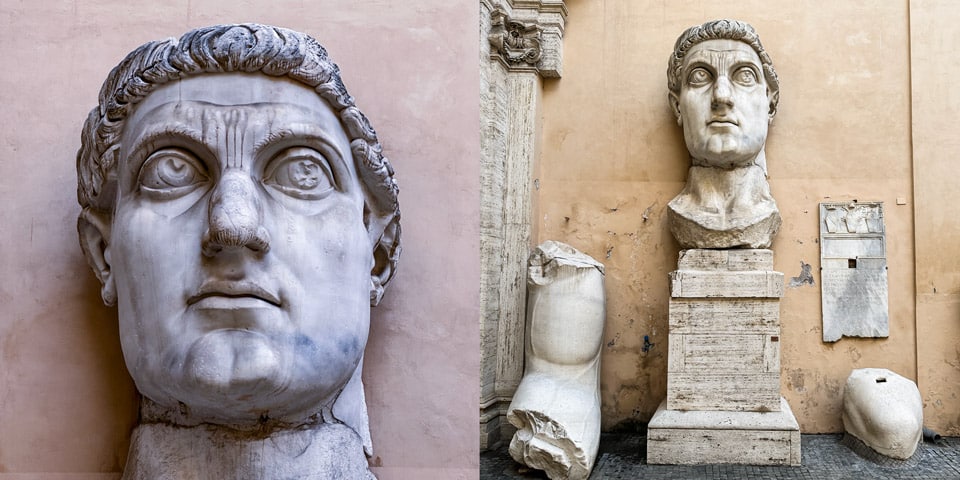
For nearly two thousand years, millions of visitors have stood in awe before the “Colosseum,” assuming the name comes from its colossal size. But here’s the twist that changes everything: the name has nothing to do with the building itself. It all started with a gigantic statue of Rome’s most hated emperor — a statue that hasn’t existed for over a millennium.
🗿 The Name That Makes No Sense
Here’s a fact that still amazes me: no ancient Roman ever called it the Colosseum. Not one.
I’ve gone through Latin texts from Rome’s golden age — Martial, Pliny, Suetonius, Tacitus — and not a single one mentions that name. They called it Amphitheatrum Flavium (the official name), sometimes Amphitheatrum Caesareum (the imperial amphitheater), or simply the arena.
So where did Colosseum come from? The answer takes us straight into the strange afterlife of Nero’s ego.
🌞 Enter the Worst Neighbor in History
To understand the name, you need to meet history’s most narcissistic architect: Emperor Nero.
After the Great Fire of 64 AD — which he may not have started, but certainly used to his advantage — Nero built his massive Domus Aurea, the Golden House. It covered a third of Rome. At its entrance, he placed a colossal bronze statue of himself as the sun god Apollo.
According to Pliny the Elder’s Natural History, it was the tallest statue in Rome, reaching about 100 to 115 feet high — taller than any structure except the temples. Sculpted by Zenodorus, it showed Nero nude except for a cloak, holding a rudder, crowned with sun rays, forged from bronze that rumor says came from melted temple treasures. It was both a masterpiece and a warning sign of imperial hubris.
🐘 The Statue’s Bizarre Journey
After Nero’s suicide in 68 AD, Rome faced a rather awkward problem: what do you do with a hundred-foot statue of a man everyone hates?
The answer, as usual in Rome, was creative pragmatism.
Under Vespasian, instead of melting down the bronze, they simply swapped the head. The statue’s face was replaced with that of Sol Invictus, the sun god. It was pure propaganda efficiency — cheaper to recycle an emperor than to rebuild him.
Then came Hadrian in 128 AD. He wanted to construct his Temple of Venus and Roma where the statue stood, but rather than demolish it, he had it moved next to the Flavian Amphitheater. According to Aelius Spartianus’ Life of Hadrian, the relocation required twenty-four elephants and a platform designed by the architect Decrianus. The statue was moved upright through the streets of Rome. I always picture that — a hundred-foot bronze god gliding through downtown, escorted by elephants — and it feels more cinematic than anything Ridley Scott could dream up.
Once beside the amphitheater, the statue and the arena became inseparable landmarks. People started saying, “Meet me at the amphitheater by the Colossus.” And just like that, the seed of the new name was planted.
📜 When “Colosseum” Actually Started
The first time “Colosseum” appeared in writing was centuries later. Around 725 AD, the English monk Bede wrote in De temporibus:
“Quandiu stabit coliseus, stabit et Roma; quando cadet coliseus, cadet et Roma.”
As long as the Colosseum stands, Rome shall stand; when the Colosseum falls, Rome shall fall.
But here’s the twist — Bede probably thought “Coliseus” referred to the statue itself, not the amphitheater. Over time, through centuries of repetition and confusion, the name of Nero’s statue became the name of Rome’s greatest building.
A medieval game of broken telephone rewrote history.
🧱 The Evidence Is Still There
In 1936, archaeologists uncovered the base of the Colossus of Nero near the amphitheater. According to excavation reports by A.M. Colini, the platform measured 17.6 by 14.75 meters and was seven meters deep, strong enough to support more than fifty tons of bronze. If you walk near the Colosseum today, you can still see where it stood — the outline is marked by a change in the pavement’s color.
Beside it once stood the Meta Sudans, a tall conical fountain described in medieval pilgrim accounts. The two landmarks were often mentioned together, showing that the statue remained standing at least until the 7th century.
Linguistic evidence seals the story. Documents from the Middle Ages show the transition step by step — first “the amphitheater near the Colossus,” then “the amphitheater of the Colossus,” and finally, simply, “the Colosseum.”
What began as a reference point became the monument’s permanent name.
🏺 The Ultimate Historical Irony
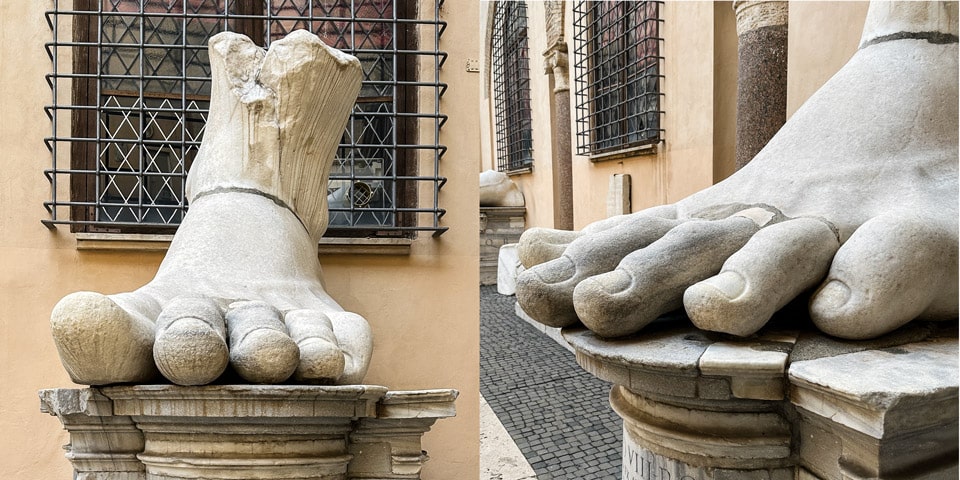
Here’s the part I can’t stop thinking about. Nero built a statue of himself so huge it dominated the city skyline. The Flavian emperors built the amphitheater precisely to erase Nero’s memory. Yet Nero’s statue ended up naming their building forever.
The dynasty that wanted their family name immortalized — the Flavians — lost that battle to their worst enemy’s vanity project. The Amphitheatrum Flavium became The Colosseum.
It’s as if the Statue of Liberty were officially called the “Freedom Monument,” but over time everyone started calling it “Big Green Lady,” and eventually forgot why.
🕰️ Why This Matters
The story of the name isn’t just trivia — it reveals how history really works. Official names mean nothing if people don’t use them. Landmarks name themselves through familiarity, not authority. Mistakes repeated long enough become truth. And not even emperors can control language.
The UCLA Digital Roman Forum has built VR reconstructions showing the Colossus standing beside the amphitheater, and when you see them together, the name suddenly makes perfect sense.
⚡ The Mystery of the Missing Colossus
So what happened to the statue? Nobody knows for sure. Some believe it toppled during the earthquake of 443 AD. Others think it was melted down by the Goths in 410 for weapons, or recycled into church bells during the Middle Ages. The romantic version says it’s still buried somewhere under modern Rome — though that’s unlikely.
The last written mention of it comes from a 7th-century pilgrim guide noting only the base. By the year 1000, the Colossus was gone — but its name had already become immortal.
🏗️ Plot Twist: Size Actually Doesn’t Matter
Here’s the irony. By the Middle Ages, when the statue was long forgotten, Romans assumed “Colosseum” meant “colossal building.” They invented an explanation that sounded logical, and it stuck.
Even today, some tourist guides repeat it without realizing they’re passing on medieval fake news. The truth is much better: it’s called the Colosseum because the Romans were too practical to waste bronze, too proud to admit a reuse, and too forgetful to remember why.
Next time you walk past the Colosseum, look for those colored paving stones marking the spot where the Colossus of Nero once stood. There, a hundred-foot bronze emperor watched over Rome for 350 years — the invisible giant who gave the eternal arena its eternal name. Sometimes what’s gone tells a better story than what remains.
📚 Sources for the Curious
Pliny the Elder, Natural History Book 34
Historia Augusta – Life of Hadrian
UCLA Digital Roman Forum – Colossus Reconstruction
Colini, A.M. “Storia e topografia del Celio” – Memorie della Pontificia Accademia, 1944
Richardson, Lawrence. A New Topographical Dictionary of Ancient Rome. Johns Hopkins University Press, 1992