The Commodus Passage: Inside the Colosseum’s Recently Opened Imperial Secret
After being closed for decades, the Commodus Passage reopened to the public in 2021. This private corridor tells the story of Rome’s most controversial emperor and reveals how power, paranoia, and spectacle intersected in ancient Rome. Here’s what makes this passage one of the Colosseum’s most fascinating features.
The Emperor Who Changed Everything
Marcus Aurelius Commodus Antoninus (161-192 AD) wasn’t supposed to rule. As the son of philosopher-emperor Marcus Aurelius, he was expected to continue stoic governance. Instead, Commodus became Rome’s most theatrical emperor, and this passage was his stage entrance.
Historical sources paint a shocking picture:
- Cassius Dio: Records Commodus fought as gladiator 735 times
- Historia Augusta: Claims he renamed Rome “Colonia Commodiana”
- Herodian: Describes him entering arena dressed as Hercules
The passage wasn’t just architecture – it was psychological armor for an emperor who trusted no one.
What the Passage Actually Is
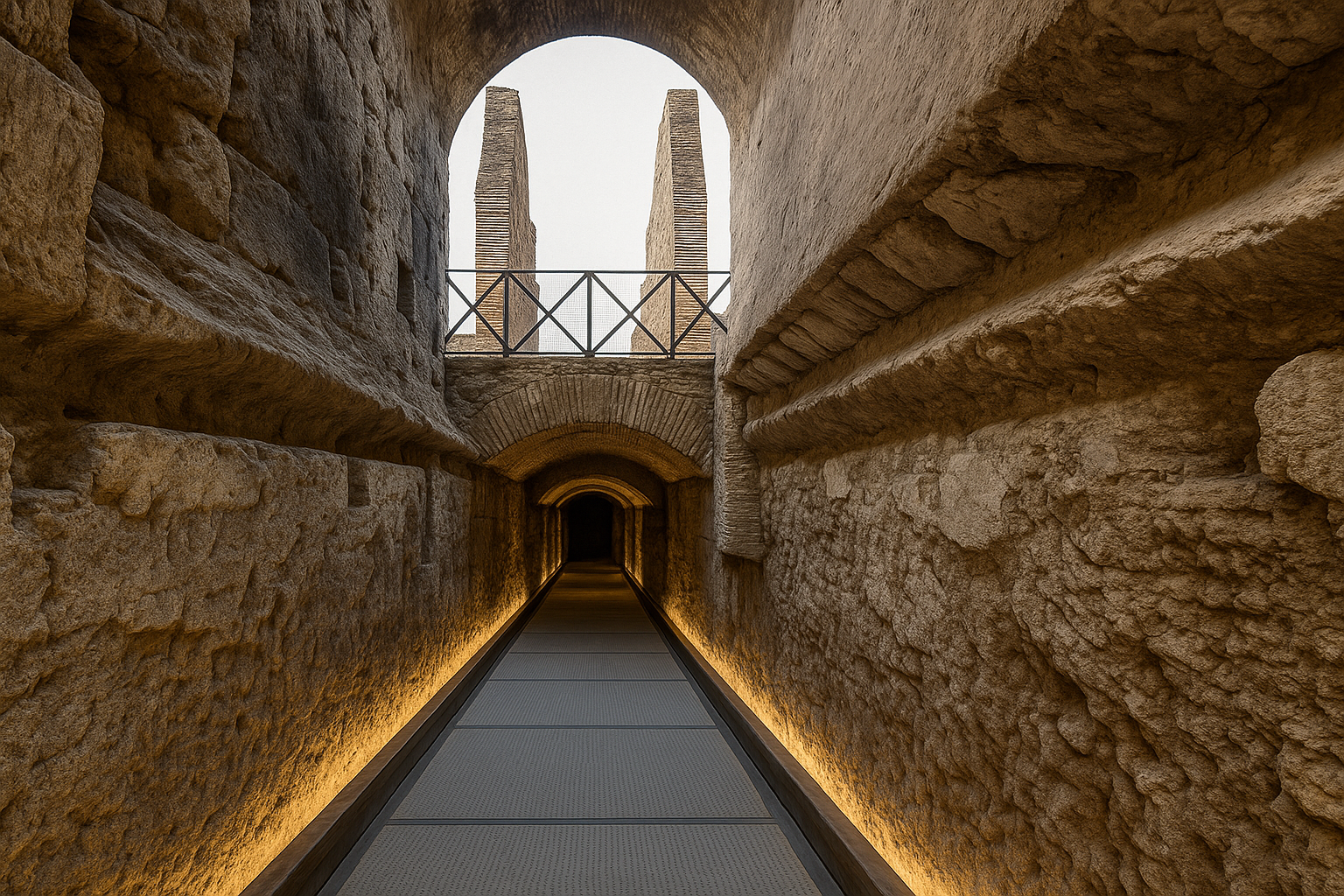
Physical Specifications
The corridor, documented in recent archaeological surveys by the Parco Archeologico del Colosseo, consists of:
- Length: 160 meters of accessible tunnels
- Width: 3.2 meters at widest points
- Height: Originally 4.5 meters (partially collapsed)
- Construction: Brick-faced concrete with travertine reinforcement
The Route to Power
The passage connected:
- Starting point: Imperial box (pulvinar) on north side
- Underground route: Beneath cavea seating
- Midpoint: Private chambers with latrine and waiting area
- Exit options: Direct arena access or escape route to Ludus Magnus
This wasn’t a simple corridor – it was an underground highway designed for one man’s safety and spectacle.
Engineering for Paranoia
The passage reveals sophisticated security features:
Triple-Lock System
Archaeological evidence shows three separate locking mechanisms:
- Bronze portcullis at entrance (hinge marks visible)
- Rotating stone door midway (pivot socket preserved)
- Iron grate before arena entry (mounting brackets remain)
Acoustic Isolation
The walls contain unusual features:
- Double-skin construction with air gap
- Pumice aggregate for sound absorption
- Offset doorways preventing sound travel
Professor Lynne Lancaster’s analysis suggests this created virtual silence – guards outside couldn’t hear conversations within.
Emergency Features
- Escape shaft: Leading to street level (now blocked)
- Weapons cache: Niches sized for gladius storage
- Water source: Lead pipe junction for fountain
The Gladiator Emperor’s Arena Obsession
Commodus didn’t just watch games – he participated. The passage enabled his theatrical entrances:
Morning Routine (per Cassius Dio):
- Dawn: Enter through passage unseen
- Sunrise: “Warm-up” killing animals
- Morning: Fight as secutor (heavily armored)
- Noon: Return via passage for lunch
- Afternoon: Preside from imperial box
He allegedly killed:
- 100 lions in single day
- Giraffe with bow and arrow
- Amputee dressed as giant (pretending to be mythical monster)
The Acta Urbis (Rome’s daily gazette) was forced to report his victories as real accomplishments.
Archaeological Discoveries in the Passage
Recent restoration (2017-2021) uncovered remarkable artifacts:
Graffiti Evidence
Over 20 inscriptions discovered, including:
- “COMMODVS HERCVLES” – supporting historical claims
- Tally marks (possibly counting appearances)
- Crude drawing of figure with club (Hercules/Commodus?)
Material Culture
- Fragments of purple porphyry (imperial stone)
- Gold leaf traces on walls
- Gaming board carved into bench (guards’ entertainment?)
- 47 coins dating 180-192 AD (Commodus’s reign)
Structural Modifications
Carbon dating and brick stamps reveal three construction phases:
- Original (80 AD): Basic service corridor under Titus
- Expansion (180-185 AD): Commodus’s early modifications
- Fortification (190-192 AD): Paranoid final years
The December 192 AD Plot
The passage played a role in Commodus’s assassination. According to Herodian:
On December 31, 192 AD, Commodus planned to sleep in the gladiator barracks and enter through this passage on New Year’s Day to kill both consuls and begin his “refounding” of Rome.
His mistress Marcia discovered the plan, poisoned his wine, and when he vomited it up, sent wrestler Narcissus to strangle him in his bath. The passage that protected him for 12 years couldn’t save him from his inner circle.
What Visitors See Today
The restored passage opened in 2021 with limited access (25 people maximum per tour). Visible features include:
Original Elements
- Brick stamps: Dating construction phases
- Opus reticulatum: Diamond-pattern brickwork
- Hydraulic concrete: Still waterproof after 1,900 years
- Metal fixtures: Bronze door hinges, iron brackets
Conservation Additions
- Glass flooring revealing foundations
- LED lighting mimicking oil lamps
- Climate control preventing deterioration
- Seismic sensors monitoring stability
According to the Special Superintendence of Rome, visitor breath moisture required installing dehumidification systems – ancient Romans didn’t account for modern tourism.
The Passage in Context
Other Imperial Passages
Commodus wasn’t alone in architectural paranoia:
- Nero: Underground tunnel to Golden House
- Domitian: Secret corridor in Palatine Palace
- Hadrian: Private access to Pantheon
But Commodus’s passage was unique – designed not for escape but for performance.
Modern Parallels
The concept persists:
- Presidential bunkers
- Celebrity service entrances
- Stadium player tunnels
The desire to control public appearance while maintaining security hasn’t changed in 2,000 years.
Why This Matters
The Commodus Passage embodies the paradox of power:
- Public visibility requiring private protection
- Strength projected through hidden vulnerability
- Popular appeal masking elite isolation
It’s architecture as psychology – walls built not just from concrete but from fear, ambition, and the eternal tension between ruler and ruled.
The Conservation Challenge
Opening the passage required solving modern problems:
- Visitor impact: Each person adds heat, humidity, CO2
- Structural integrity: 30% of vaulting needs support
- Light damage: LED installation without drilling ancient walls
- Emergency exit: Modern safety requiring minimal intervention
The solution involved 3D laser scanning by the University of Rome creating millimeter-accurate models, allowing virtual tours for those who can’t access the physical space.
Visiting Today
Access: Special ticket required (€15 supplement)
Group size: Maximum 25 people
Duration: 45-minute guided tour
Languages: English, Italian, Spanish
Physical requirements: 160 steps, narrow passages
The passage tells a story modern Rome prefers to forget – that its most famous monument served not just public entertainment but private madness.
Standing in Commodus’s passage, you understand that power corridors aren’t metaphorical. They’re literal spaces where decisions happen in darkness, where paranoia builds walls, and where even emperors need escape routes. This passage didn’t protect Commodus from his fate, but it preserved his story in stone – sometimes that’s the only immortality anyone gets.
Primary Sources & Modern Research:
- Parco Archeologico del Colosseo – Passage Restoration
- Special Superintendence Rome – Conservation Project
- University of Rome 3D Documentation
- Cassius Dio, Roman History Book 73
- Herodian, History of the Empire Book 1
- Hekster, Olivier. Commodus: An Emperor at the Crossroads. Brill, 2002