Two Companies Control 28% of the Last Supper Market — And What That Means for Travelers
Two operators control 28% of all Last Supper tours in Milan. Only 1,720 visitors per day. What happens when extreme scarcity meets market concentration — and what tourists can do about it.
Leonardo’s Last Supper is a 15-minute experience. You enter a climate-controlled room in Milan’s Santa Maria delle Grazie with 39 other people, you look at one of the most important paintings in human history, and after exactly 15 minutes, you leave. The official ticket costs €15.
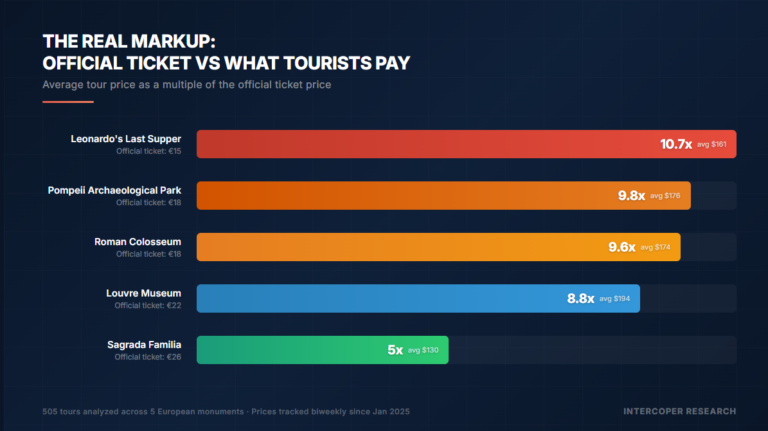
The average tourist pays $161. That is a 10.7x markup — the highest of any major monument in Europe. And after spending 16 months tracking the data behind that number, I believe the markup is not just a consequence of scarcity. It is a consequence of market structure.
Two companies — Wander Italy and Memento — control 28% of every tour product available for the Last Supper. At no other major European monument do so few operators hold so much of the market. And that concentration has direct consequences for what travelers pay.
The Scarcity Is Real — And Permanent
Before I talk about market structure, the scarcity needs to be understood. It is not artificial. It is not a marketing tactic. It is physics.
The viewing room at the Cenacolo Vinciano admits exactly 40 people every 15 minutes. No exceptions. The fresco is fragile — humidity, CO2 from breathing, temperature fluctuations all threaten a painting that has already survived bombings, floods, and centuries of neglect. The visitor cap exists to protect the work. It cannot be raised.
That means approximately 1,720 visitors per day. Roughly 350,000 per year. For context, the Colosseum admits over 41,000 daily — 24 times more. The Louvre processes 30,000. Pompeii has no hard cap.
The Last Supper admits fewer people per day than most restaurants serve for lunch. In a city that receives over 10 million tourists per year, 1,720 daily slots create a supply-demand imbalance that no amount of pricing, marketing, or operational efficiency can resolve. The scarcity is structural, permanent, and non-negotiable.
This alone would push prices above the official €15 ticket. But scarcity by itself does not explain a 10.7x markup. Scarcity plus market concentration does.
28% in Two Hands
We analyzed every active tour product for the Last Supper on GetYourGuide — 35 products total. That is the entire addressable market for guided Last Supper tours on Europe’s largest tour platform.
Wander Italy offers 5 products. Memento offers 5 products. Together, they hold 28% of the market. The top 5 operators control 55%.
Compare that to every other monument in our 505-tour dataset:
Colosseum: 76 tours, top 3 control 18%. Sagrada Familia: 81 tours, top 3 control 16%. Louvre: 94 tours, top 3 control 17%. Pompeii: 219 tours, top 3 control 17%.
At those monuments, dozens of operators compete aggressively on price, duration, group size, language, and cancellation policy. No single company can set the market price. At the Last Supper, two companies hold more than a quarter of all available products — in a market where the total product count is 35.
The numbers tell a clear story: the Last Supper has the highest market concentration AND the highest markup of any major European monument. The correlation is not a coincidence.
Why Concentration Matters for Prices
In a fragmented market, operators compete for customers by lowering prices, adding value, or differentiating their products. If one Colosseum tour charges $80, another operator can offer a similar tour at $65 and capture the price-sensitive segment. This competitive pressure keeps markups in check — which is why the Sagrada Familia, with 81 tours and no dominant operator, has only a 5x markup.
In a concentrated market, this pressure disappears. When two operators hold 28% of a 35-product market, they do not need to compete on price. The scarcity guarantees demand regardless of pricing. A tourist who has traveled to Milan specifically to see the Last Supper and discovers the official €15 ticket is sold out will pay $100, $150, or $200 for a guided tour — because the alternative is not seeing the painting at all.
In economic terms, the Last Supper tour market is an oligopoly operating within a supply-constrained environment. The operators are not colluding — they do not need to. The market structure does the work for them. When supply is fixed at 1,720 visitors per day and demand exceeds that by a factor of ten, any operator with a ticket allocation can charge whatever the market will bear.
And the market will bear 10.7x.
The Barrier to Entry Nobody Talks About
At the Colosseum, a new tour operator can apply for guide licenses, purchase ticket blocks, build a product, and list it on GetYourGuide within months. The capacity is large enough that new entrants do not threaten existing operators’ access. Competition can grow.
At the Last Supper, the barrier is the ticket itself. The daily cap of 1,720 visitors means the total number of available ticket blocks is finite and small. Existing operators with long-standing relationships and established allocations hold those blocks. A new entrant cannot simply “buy more tickets” because there are no more tickets to buy.
This creates a self-reinforcing cycle: established operators hold ticket blocks → they control the market → their pricing power stays high → new operators cannot get ticket blocks → the market stays concentrated → pricing power remains unchallenged.
The result is a market where the product catalog (35 tours) has barely changed in the 16 months we have been tracking it. No new entrant has disrupted the top 5. No price war has broken out. No operator has aggressively discounted to capture share. The market is static — frozen by scarcity at the supply level and concentration at the operator level.
The €15 Ticket That Almost Nobody Gets
The official €15 ticket exists. It is purchasable at cenacolovinciano.org. It provides the same 15-minute viewing experience as a $161 guided tour.
In theory, any tourist can buy it. In practice, almost nobody does.
The official booking system releases tickets in irregular batches, typically 2 to 3 months before the visit date. The release schedule is not publicly announced. The website is functional but not optimized for international tourists who do not speak Italian. Popular dates sell out within hours of release. There is no waitlist, no notification system, and no second chance if you miss the window.
The result: the €15 ticket becomes a lottery that rewards tourists who happen to check the website at the right moment, weeks before their trip. Everyone else — the vast majority of visitors — turns to the tour market, where the average price is $161 and the cheapest reliable option is around $100.
The friction in the official system is not intentional — the Cenacolo Vinciano is a small institution managing a conservation site, not a tech company optimizing conversion funnels. But the friction has economic consequences. Every tourist who fails to navigate the official system becomes a customer for the tour market. And the tour market is waiting with a 10.7x markup.
What Other Monuments Can Learn from the Sagrada Familia
The Sagrada Familia is proof that scarcity does not automatically produce extreme markups. The basilica admits approximately 15,000 visitors per day — more than the Last Supper, but still a fraction of the Colosseum’s 41,000. Demand is high. Slots sell out in advance.
Yet the markup is only 5x — half the Colosseum’s and less than half the Last Supper’s.
Two structural differences explain the gap. First, the Sagrada Familia’s official booking system is well-designed: multilingual, fast, with clear pricing and availability calendars. Tourists can buy the €26 ticket with an audioguide in 19 languages without frustration. The official channel works — so fewer tourists are forced into the tour market.
Second, Barcelona’s tour market is highly fragmented. 81 products, no operator above 6%, aggressive competition on price and inclusions. The top 3 operators control only 16% — the lowest concentration of any monument in our study. When competition is real, markups compress.
The Sagrada Familia model suggests that the Last Supper’s 10.7x markup is not inevitable. It is a consequence of two fixable problems: a poor official booking system and a concentrated operator market. Fix the first — build a modern, multilingual ticketing platform with transparent release schedules and email notifications — and you reduce the flow of tourists into the third-party market. The second problem (concentration) would face organic pressure as demand for third-party tours decreased.
But fixing institutional booking systems requires institutional will. And institutions managing fragile 500-year-old masterpieces have priorities that do not include UX optimization.
What This Means If You Are Planning to See the Last Supper
I am not going to tell you the 10.7x markup is unfair. The scarcity is real. The operators provide real services — guides, logistics, skip-the-line management, multilingual support. A good Last Supper tour that includes a Milan walking tour, a knowledgeable guide, and guaranteed access to the painting is a legitimate product.
But you should understand the market you are entering:
Your leverage is close to zero. With 35 products and two dominant operators, you cannot comparison-shop the way you can at the Colosseum or Sagrada Familia. The price range is narrower, the options are fewer, and discounting is rare.
The official €15 ticket is your only real alternative. If you can get it — by checking cenacolovinciano.org 2 to 3 months before your visit, setting calendar reminders for release dates, and being ready to book the moment tickets appear — you save approximately $146 per person. For a couple, that is nearly $300. It is worth the effort.
The median ($115) is a better target than the average ($161). A small number of luxury and private tours inflate the average. At $115, you get a well-reviewed small-group tour with a guide and guaranteed access. That is the real market price for a standard Last Supper experience — not the $161 that the average suggests.
This market will not change on its own. The scarcity is permanent. The concentration is self-reinforcing. The official booking system is unlikely to modernize quickly. If you are planning to see the Last Supper in 2026 or 2027, these are the conditions. Plan accordingly.
Mario Dalo is the founder of Intercoper (est. 2006), a Buenos Aires-based digital studio that operates travel platforms covering Europe’s most visited cultural landmarks. The market concentration data referenced in this article comes from Intercoper’s analysis of 505 tours across 5 European monuments, with specific focus on 35 Last Supper tour products tracked biweekly since January 2025.