The Tour Industry’s Pricing Problem: What 505 Tours Reveal About Markup Economics
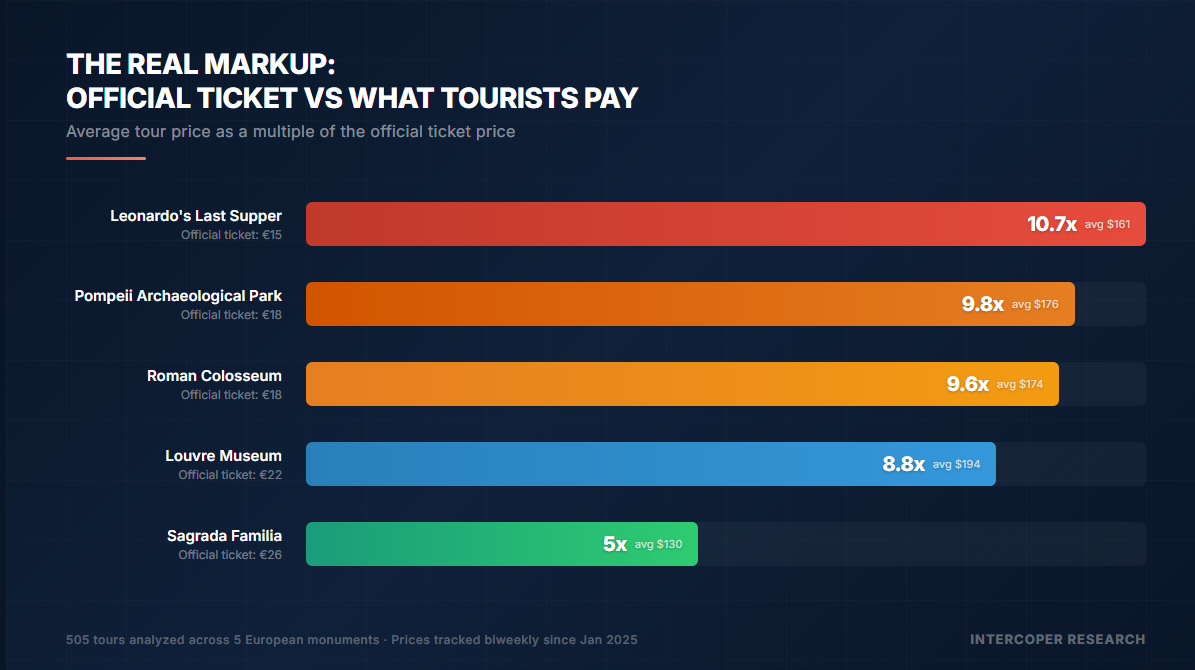
The Colosseum sells a ticket for €18. The average tourist pays $174. That is a 9.6x markup. Leonardo’s Last Supper sells a ticket for €15. The average tourist pays $161. That is 10.7x — the highest markup of any major monument in Europe.
These are not estimates. They come from our analysis of 505 tour products across five European monuments — data we track biweekly through automated monitoring. And after 16 months of watching these numbers, I have reached a conclusion that will make some people in the tour industry uncomfortable: the pricing model is not broken by accident. It is broken by design.
The Numbers Nobody Wants to Publish
I run Intercoper, a portfolio of travel sites covering the Colosseum, Sagrada Familia, Louvre, Last Supper, and Pompeii. When we built our automated price tracking system, the original purpose was practical — keep our tour listings current. But once we had 16 months of pricing data across 505 products, the patterns became impossible to ignore.
Every major European monument shows the same structure: a low official ticket price that most tourists never access, and a tour market that charges multiples of that price for a guided, managed, skip-the-line experience.
The Colosseum: €18 official, $174 average tour. 9.6x markup. Pompeii: €18 official, $176 average tour. 9.8x markup. Louvre: €22 official, $194 average tour. 8.8x markup. Last Supper: €15 official, $161 average tour. 10.7x markup. Sagrada Familia: €26 official, $130 average tour. 5x markup.
These markups are not hidden. Anyone can see the prices on GetYourGuide. But nobody has published the comparison — the systematic gap between what the government charges and what the market charges. That gap tells a story about how the tour industry actually works.
The Official Ticket Is Not Really Available
Here is the part the industry does not advertise: the official ticket exists, but for most tourists, it is functionally inaccessible.
At the Last Supper, the €15 ticket sells out weeks in advance through an unintuitive booking system that most international visitors never find. At the Colosseum, the €18 ticket is released 30 days before each date and popular slots disappear within hours. At the Louvre, the €22 ticket is available but buried behind a French-language booking portal that many visitors give up on.
The tour industry fills this gap. Operators purchase ticket blocks months in advance, bundle them with guides and skip-the-line management, and resell the package at 5x to 10.7x the face value. They are not creating artificial scarcity — the scarcity already exists in the official systems. They are monetizing it.
This is not inherently wrong. Operators provide real services: guides, logistics, crowd management, multilingual support, flexible cancellation. But the pricing is not set by the cost of those services. It is set by how hard it is for the tourist to get the official ticket on their own. The harder the ticket, the higher the markup. That is why the Last Supper (1,720 visitors per day, terrible booking system) has a 10.7x markup, and the Sagrada Familia (15,000 visitors per day, clean booking portal) has only 5x.
The Price Is Not Based on Cost — It Is Based on Frustration
If tour prices were based on cost of service, you would expect similar markups across all five monuments. A guide in Rome costs roughly the same as a guide in Milan. Platform commissions are the same percentage everywhere. Insurance, headsets, and logistics scale similarly.
But the markups range from 5x to 10.7x. The variation has nothing to do with what the tour costs to deliver. It has everything to do with how frustrated the tourist is when they try to buy the official ticket and fail.
At the Last Supper, the frustration is extreme. The official booking system is confusing, the dates are limited, and the daily capacity is capped at 1,720 people. By the time a tourist discovers that the €15 ticket is sold out for their entire trip, they will pay almost anything for guaranteed access. The 10.7x markup is not the cost of a guide — it is the price of relief from frustration.
At the Sagrada Familia, the frustration is low. The official website is well-designed, tickets are available in multiple languages, the audioguide is included at €26, and the daily capacity is around 15,000. Tourists can usually get the official ticket without help. So the tour markup stays at 5x — the lowest in Europe — because operators cannot charge a premium for solving a problem that barely exists.
The data reveals a pricing model based on friction, not on value. The harder the institution makes it to buy the official ticket, the more room the tour industry has to charge for access.
The Market Concentration Problem
Pricing power does not come only from friction. It also comes from market structure.
At the Last Supper, two operators — Wander Italy and Memento — control 28% of all 35 available tours. The top 5 operators control 55%. With only 1,720 daily visitors and a tiny product catalog, there is no room for aggressive price competition. New entrants cannot easily get ticket allocations. Existing operators face almost no pressure to discount.
At the Sagrada Familia, the picture is the opposite. 81 tours, no operator above 6%, top 3 controlling only 16%. The market is fragmented. Dozens of companies compete on price, duration, group size, and inclusions. When that many operators fight for the same customer, margins compress.
The correlation is direct and consistent across all five monuments: more concentrated market = higher markup. More fragmented market = lower markup. This is textbook market economics, but nobody has applied it to the European tour industry with actual data before.
The implication for travelers is straightforward: at monuments with concentrated markets (the Last Supper), your negotiating power is close to zero. At monuments with fragmented markets (the Sagrada Familia, the Colosseum, Pompeii), you have real leverage — compare options, check reviews, and shop on price.
What the Tourism Industry Could Do (But Probably Will Not)
The markup problem has a solution that is obvious but unlikely: institutions could make their official tickets easier to buy.
If the Cenacolo Vinciano in Milan built a modern, multilingual booking system with adequate advance purchase windows and email confirmations, more tourists would buy the €15 ticket directly. The tour industry’s 10.7x markup would compress because operators could no longer charge a premium for solving a frustration that no longer existed.
If the Colosseum archaeological park simplified its booking flow, offered combined tickets with clear English-language descriptions, and released tickets further in advance, the 9.6x markup would face downward pressure.
The Sagrada Familia already did this. Their official website is clean, fast, multilingual, and includes a comprehensive audioguide in the base ticket. The result: the lowest markup in Europe. The market proved that when institutions respect the tourist’s ability to buy independently, the tour industry’s pricing power shrinks.
But institutional reform is slow. Government-run cultural sites have limited incentives to optimize their digital infrastructure. The Colosseum’s booking system has improved marginally in recent years. The Last Supper’s system has barely changed in a decade. As long as the friction exists, the markup will exist.
What This Means for Travelers Right Now
I am not going to tell tourists to boycott the tour industry. The services are real — a good guide at the Colosseum genuinely transforms the experience, and skip-the-line management saves hours in peak season.
But travelers should understand three things the industry does not volunteer:
The official ticket is always the floor. Before paying $174 for a Colosseum tour, check colosseo.it. The €18 ticket provides the same entry. You are paying the other $156 for a guide, logistics, and the convenience of not having to navigate the official system yourself. Decide whether those services are worth that premium for your specific visit.
The median is a better benchmark than the average. At every monument, a small number of luxury and private tours inflate the average price dramatically. The Colosseum’s median is $99 — nearly half the $174 average. The Louvre’s median is $128 versus the $194 average. Buying near the median gets you a well-reviewed, standard guided experience without paying for VIP extras.
Market structure determines your leverage. At the Last Supper (concentrated market, limited supply), your options are narrow and prices are fixed. At the Colosseum (fragmented market, many operators), you have dozens of options and real price competition. Know which situation you are in before you book.
The Data Will Keep Updating
Our automated tracking system continues to run biweekly. The 505-tour dataset grows with every scrape. If the Colosseum changes its pricing, if a new operator enters the Last Supper market, if the Sagrada Familia’s markup shifts — we will see it in the data before it shows up in anyone’s blog post.
The tour industry’s pricing model is not going to change because one research study exposed the markups. But it might change — slowly, incrementally — if travelers start making decisions based on data instead of on the price tag that appears first in their Google search.
That is what our sites are for. Not to tell people what to buy, but to show them what things actually cost — and let them decide for themselves whether the markup is worth it.
Mario Dalo is the founder of Intercoper (est. 2006), a Buenos Aires-based digital studio that operates travel platforms covering Europe’s most visited cultural landmarks. The pricing data referenced in this article comes from Intercoper’s automated tracking of 505 tours across the Colosseum, Sagrada Familia, Louvre, Leonardo’s Last Supper, and Pompeii — monitored biweekly since January 2025.