Paying More Doesn’t Mean Better: What 433 Tour Ratings Taught Me About Value
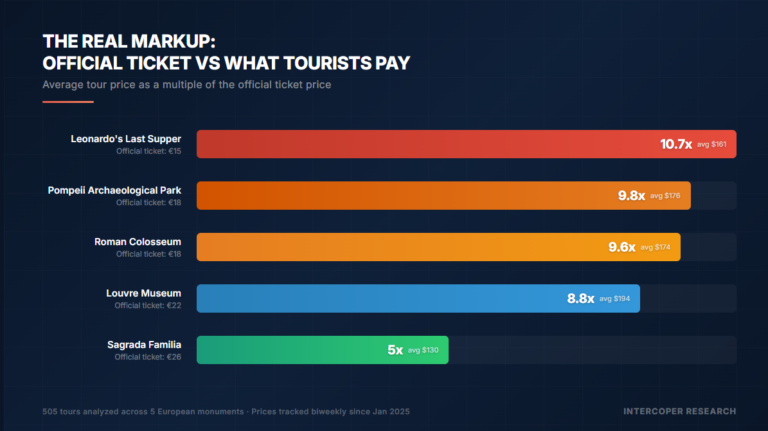
I run five travel sites that collectively track 505 tour products across Europe’s most visited monuments. I have spent 16 months watching prices, ratings, and reviews update biweekly through automated monitoring. And after all that data, I can tell you the single most expensive assumption in European tourism: that paying more gets you a better experience.
It does not. We proved it.
The Test: Does Price Predict Satisfaction?
We ran the simplest possible analysis on 433 tours with valid price and rating data across the Colosseum, Sagrada Familia, Louvre, Last Supper, and Pompeii. The question: is there a statistically meaningful relationship between what a tour costs and how visitors rate it?
The Pearson correlation coefficient: 0.155.
For non-statisticians, that number means essentially nothing. A perfect correlation is 1.0. A strong correlation starts around 0.7. At 0.155, price and satisfaction are barely connected. Knowing what a tour costs tells you almost nothing about whether visitors will enjoy it.
This finding should concern every tourist who has ever used price as a shortcut for quality — which is most of us. When you see two Colosseum tours, one at $50 and one at $200, the instinct is to assume the $200 tour is four times better. The data says that assumption is wrong.
0.34 Stars for 10x the Price
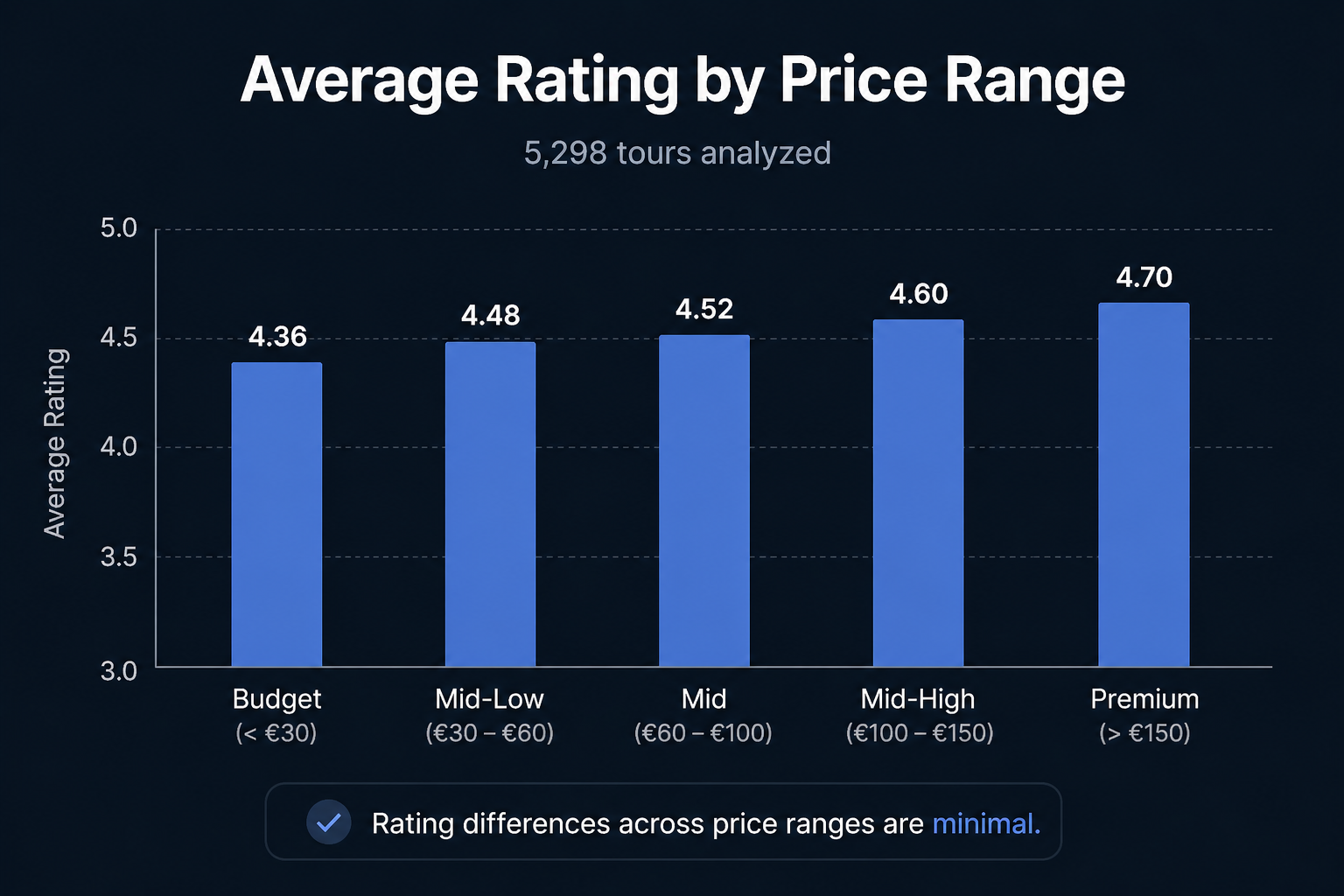
The data breaks into five price tiers. The pattern is consistent and devastating for premium pricing.
Budget tours ($0–$50) average 4.36 out of 5. Mid-range ($51–$100) averages 4.57. Premium ($101–$200) averages 4.59. Luxury ($201–$500) averages 4.70. Ultra-luxury ($500+) averages 4.70.
The full gap between the cheapest and the most expensive tier: 0.34 stars. The price gap: up to 10x.
But here is the number that really matters: mid-range tours at $51–$100 already score 4.57 — within 0.13 stars of the luxury tier. The quality curve flattens almost completely after $50. Every dollar spent beyond that buys almost nothing in customer satisfaction.
If you are a tourist choosing between a $60 Colosseum tour and a $250 Colosseum tour, the data says your expected satisfaction improvement is about one-tenth of a star. That is not value. That is a premium for the feeling of having bought something expensive.
The Most Popular Tour in Europe Costs $40
If price determined quality, the most popular tours would be the most expensive ones. They are not. They are not even close.
The single most reviewed tour product in our entire dataset is the Sagrada Familia Audio Guide Entry Ticket. It costs $40. It has 109,040 reviews. It scores 4.6 out of 5.
It is the simplest possible product — an entry ticket with an audio guide app. No private guide, no VIP access, no small group, no hotel pickup. And more people have bought, used, and positively reviewed it than any other tour across all five monuments.
The next most popular products are Colosseum guided tours priced between $55 and $81, with 34,000 to 79,000 reviews each, all scoring 4.7 to 4.8. These are standard, mid-priced group tours. Not premium. Not luxury. Standard.
The tours that the most people choose — and the most people rate highly — sit in the $40 to $100 range. The market has already voted on what delivers the best experience. It is not the $400 private tour with 30 reviews. It is the $58 guided tour with 79,000.
Perfect 5.0 Ratings Are Cheap
Only three tours in the entire 433-tour dataset hold a perfect 5.0 rating with 50 or more reviews. I expected them to be the most expensive options. They are not.
$58 — Louvre Certified Guide Tour: Mona Lisa & Masterpieces. 69 reviews. $65 — Pompeii Archaeologist Tour with 12-Person Groups. 164 reviews. $147 — Pompeii and Herculaneum Dual-Site Archaeologist Tour. 241 reviews.
Two of the three best-rated tours in Europe cost less than $65. The third is $147 — a premium product, but not luxury by any measure.
No tour above $200 holds a 5.0 rating in this dataset. Not a single one.
The pattern across all three perfect-score tours is identical and has nothing to do with price: small groups (12–15 people), specialist guides (archaeologists, certified art historians), and focused itineraries that go deep on one or two sites instead of rushing through four. These are not cheap tours or expensive tours — they are well-designed tours operated by experts who care about the subject matter.
Price did not make them great. Design did.
The Expensive Tours Nobody Tests
Here is the statistical problem with luxury tour ratings that the industry never discusses: they are based on tiny sample sizes.
Budget tours average 5,125 reviews per product. Mid-range tours average 4,120. Premium tours average 1,266. Luxury tours average 56. Ultra-luxury tours average 68.
Read those numbers again. The cheapest tours have been stress-tested by thousands of customers. The most expensive tours have been reviewed by a few dozen. A single bad experience on a luxury tour can move the average by a full tenth of a star. On a budget tour with 5,000 reviews, a bad experience is a rounding error.
Luxury tour ratings are statistically fragile. Budget and mid-range ratings are battle-tested.
When a $300 private tour shows 4.8 stars based on 25 reviews, and a $55 group tour shows 4.7 stars based on 3,000 reviews, the cheaper tour is the more reliable data point. The expensive tour’s rating could change dramatically with the next five reviews. The cheap tour’s rating is locked in by volume.
This is not a knock on luxury tours. Many of them are excellent. But their ratings should be read with extreme caution, because the sample sizes are too small to be statistically confident. A tourist who pays $300 based on 25 five-star reviews is making a decision on insufficient evidence.
The Worst Value in European Tourism
If paying more guaranteed quality, expensive tours would never score badly. But they do. Consistently.
The worst-value products in our dataset — high price, low rating — are concentrated in two categories: multi-attraction passes and full-day combo tours.
The Paris Pass Plus costs $211 and scores 3.8 out of 5 with 595 reviews. A Private Louvre Guide costs $295 and scores 4.0 with 41 reviews. Three Pompeii-Herculaneum-Vesuvius combo tours priced at $141–$147 each score between 3.4 and 3.9.
The pattern: products that try to do too much in one day at a premium price consistently underdeliver. They promise “everything” — five attractions, hotel pickup, lunch included, all-day guide — and deliver a rushed, exhausting experience where you skim every surface without absorbing anything.
The products with the highest satisfaction do the opposite. They focus on one site, go deep, and end before the visitor is exhausted. A 2.5-hour Colosseum tour with a knowledgeable guide consistently outscores a 7-hour Rome mega-tour that hits the Colosseum, Vatican, Pantheon, and Trevi Fountain.
More is not better. Focused is better.
Why We Use Price as a Proxy (And Why We Should Stop)
I understand why tourists equate price with quality. In most consumer markets, it works. A $200 hotel is usually better than a $50 hotel. A $80 restaurant meal is usually better than a $15 one. Price correlates with quality when the product has variable production costs — better ingredients, better materials, better locations.
Tours do not work this way. The Colosseum is the same building whether you paid $50 or $300 to enter it. The guide is the variable — and guide quality does not scale linearly with tour price. A passionate archaeologist leading a $65 Pompeii tour can deliver a better experience than a bored generalist leading a $200 private tour. The guide’s expertise, enthusiasm, and communication skills are independent of the price on the booking page.
The tour industry benefits from the price-quality assumption because it allows premium pricing without proportional quality improvement. If tourists stopped using price as a proxy and started reading reviews instead, the pricing structure would face real pressure. But as long as the assumption holds — “more expensive means better” — operators can charge 10x for 0.34 extra stars, and the market accepts it.
The data says the market should not accept it. A 0.155 correlation is not a quality signal. It is noise.
What I Would Tell a Tourist About to Book
After 16 months of data across 433 tours, three rules:
Stop looking at the price first. Look at the review count, then the rating, then the recent review text, then the price. A tour with 2,000 reviews at 4.7 stars is a more reliable choice than a tour with 30 reviews at 4.9 stars — regardless of which one costs more.
Buy between $50 and $100. This is the sweet spot across all five monuments. Mid-range tours score within 0.13 stars of luxury products at a fraction of the cost. The quality curve is flat above $50. You are paying for the experience of buying something expensive, not for a proportionally better experience.
Look for small groups and specialist guides — not for high prices. The three perfect-score tours in our dataset share two traits: groups of 12 to 15 people and guides who are genuine experts (archaeologists, certified art historians). These traits exist at $58 and at $147. They do not require $300. The product design predicts satisfaction. The price tag does not.
Mario Dalo is the founder of Intercoper (est. 2006), a Buenos Aires-based digital studio that operates travel platforms covering Europe’s most visited cultural landmarks. The analysis referenced in this article is based on 433 tours with valid price and rating data, tracked biweekly since January 2025 across the Colosseum, Sagrada Familia, Louvre, Leonardo’s Last Supper, and Pompeii.