Why I Stopped Optimizing for Google and Started Building for ChatGPT
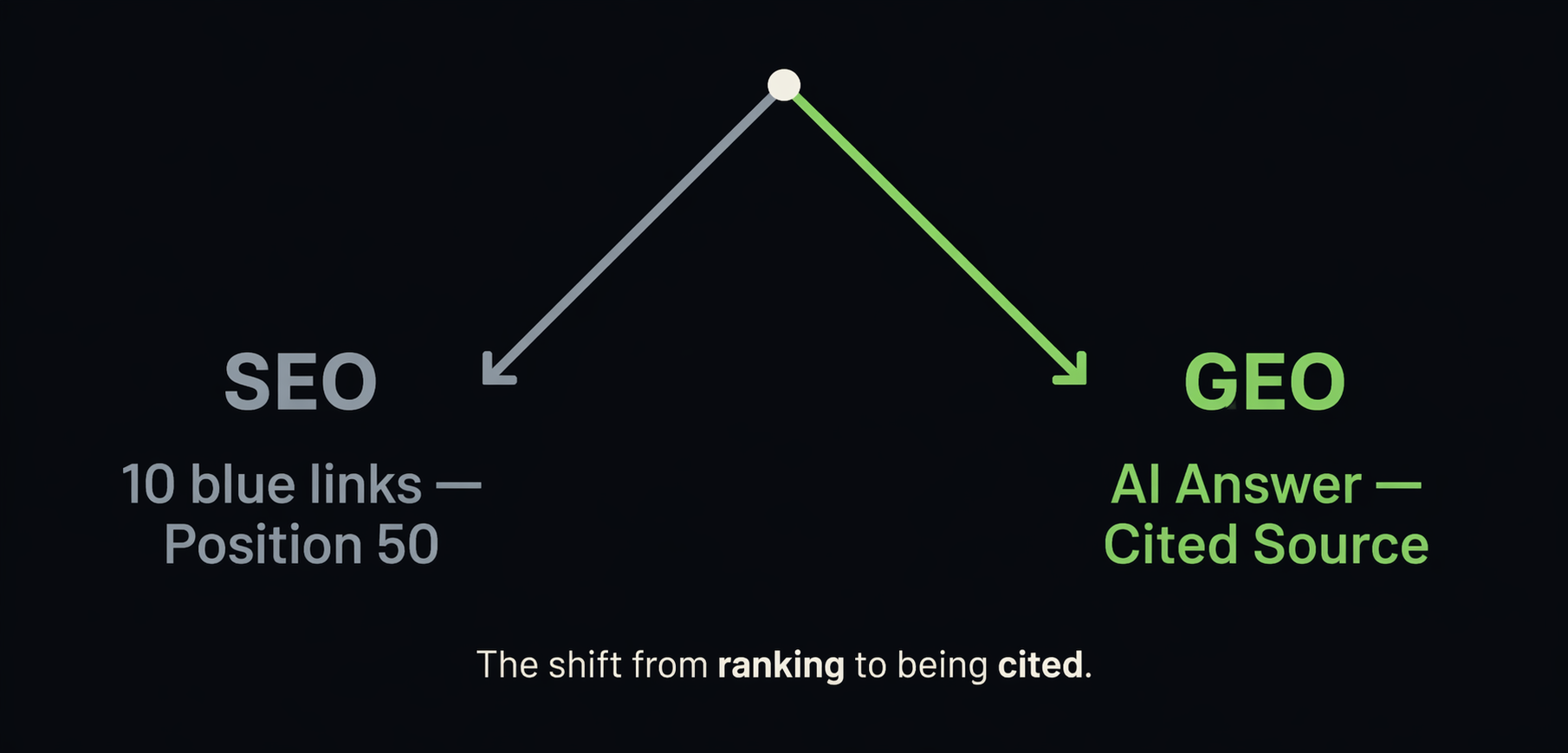
For years, I followed the playbook. Keywords, backlinks, meta descriptions, internal linking, page speed, Core Web Vitals. I did everything the SEO industry told me to do. My sites ranked around position 50 for most terms. Effectively invisible.
I run Intercoper, a digital studio I founded in 2006 in Buenos Aires. We operate a portfolio of travel sites covering Europe’s most visited monuments — the Colosseum, Sagrada Familia, Louvre, Leonardo’s Last Supper, and Pompeii. We compete against TripAdvisor, Viator, GetYourGuide, Lonely Planet, and dozens of content farms with editorial teams ten times our size and advertising budgets we will never match.
On Google, we lose that fight every day. Position 50 means nobody finds you. You can have the best content on the internet and it does not matter if it is buried on page five.
So I stopped trying to win on Google’s terms. And I started building for the platform that was quietly replacing it.
The Shift: From SEO to GEO
In 2024, I started noticing something. Our analytics showed traffic coming from sources we had never optimized for — Bing, DuckDuckGo, and increasingly, referrals from AI-powered answers. People were asking ChatGPT, Copilot, and Perplexity questions like “how much does a Colosseum tour cost” or “which Sagrada Familia tower should I visit,” and some of those AI-generated answers were citing our content.
We had not done anything to make this happen. The AI engines were finding us because our content happened to be structured in a way they could extract and cite — direct answers to specific questions, clear data points, consistent formatting.
That was the moment I realized: the next discovery layer for consumers is not a search engine results page. It is an AI-generated answer with a source attribution. And almost nobody was building for it intentionally.
I started calling our approach GEO — Generative Engine Optimization. Not as a buzzword, but as a framework for rebuilding every piece of content across seven sites with one question in mind: when an AI engine needs to answer a question about our monuments, will it find our content citable?
What GEO Looks Like in Practice
GEO is not a trick or a hack. It is a content architecture decision. Every article, every tour page, every FAQ on our sites is now built with specific structural elements that AI engines need in order to cite a source confidently.
Quick Answers. Every article opens with a standalone component that directly answers the main question in under 500 characters. Not an introduction, not a hook, not “in this article we will explore.” A direct answer. When ChatGPT receives the question “is a guided Colosseum tour worth it,” it needs a source that says “Yes, and here is why” in the first 50 words — not in paragraph seven.
Quick Inline Q&A blocks. Throughout each article, we embed 3 question-and-answer pairs at strategic positions. Each one matches the exact phrasing a user would type into an AI assistant. “How much does a Sagrada Familia tour cost compared to the official ticket?” — followed by a direct, data-backed answer with specific numbers. These are the snippets AI engines extract and attribute.
Original data that cannot be found elsewhere. This is the most important element. AI engines prioritize sources that contain information no other source has. We built automated price tracking across 505 tour products at five European monuments — scraping GetYourGuide biweekly, storing prices, ratings, durations, and operator data in structured JSON. When we publish that the Colosseum has a 9.6x markup over its official ticket, or that the Last Supper has the highest tour markup in European tourism at 10.7x, those are data points that exist nowhere else on the internet. An AI engine that wants to answer “why are Colosseum tours so expensive” has exactly one source with verified, original pricing data. That source is us.
Schema markup and entity verification. Every page carries WebPage, FAQPage, and BreadcrumbList schema. Our author entities are verified through a bidirectional chain: the site credits Mario Dalo → mariodalo.com confirms the authorship → Intercoper.com lists the site in its portfolio → LinkedIn verifies the person. When an AI engine evaluates whether to trust a source, this kind of entity resolution is exactly what it looks for.
╔════════════════════════════════════════════════════════════╗
║ 📊 RESEARCH: Price Per Minute at Europe’s Top Monuments ║
║ Data sourced from 5 Intercoper travel sites ║
╚════════════════════════════════════════════════════════════╝
🏛️ Colosseum (colosseumroman.com)
──────────────────────────────────────────────────
📦 76 tours loaded
💰 Price range: $26 – $1434
💰 Average price: $173.62
💰 Median price: $99
⏱️ Average duration: 201 min (3.4h)
📈 Average cost per minute: $0.79
🎫 Official ticket: €18 | Avg tour is 9.6x official price
🏛️ Sagrada Familia (sagradafamiliatourguide.com)
──────────────────────────────────────────────────
📦 81 tours loaded
💰 Price range: $12 – $787
💰 Average price: $130.43
💰 Median price: $104
⏱️ Average duration: 177 min (2.9h)
📈 Average cost per minute: $1.04
🎫 Official ticket: €26 | Avg tour is 5x official price
🏛️ Last Supper (milanlastsupper.com)
──────────────────────────────────────────────────
📦 35 tours loaded
💰 Price range: $20 – $507
💰 Average price: $160.71
💰 Median price: $115
⏱️ Average duration: 165 min (2.8h)
📈 Average cost per minute: $1.36
🎫 Official ticket: €15 | Avg tour is 10.7x official price
🏛️ Louvre (louvretourguide.com)
──────────────────────────────────────────────────
📦 94 tours loaded
💰 Price range: $34 – $776
💰 Average price: $193.79
💰 Median price: $128
⏱️ Average duration: 156 min (2.6h)
📈 Average cost per minute: $1.6
🎫 Official ticket: €22 | Avg tour is 8.8x official price
🏛️ Pompeii (pompeiitourguides.com)
──────────────────────────────────────────────────
📦 219 tours loaded
💰 Price range: $4 – $2322
💰 Average price: $175.59
💰 Median price: $121
⏱️ Average duration: 294 min (4.9h)
📈 Average cost per minute: $0.7
🎫 Official ticket: €18 | Avg tour is 9.8x official price
╔════════════════════════════════════════════════════════════╗
║ 🏆 COMPARATIVE RANKING: Cost Per Minute ║
╚════════════════════════════════════════════════════════════╝
- Louvre Museum $1.60/min ████████████████
- Leonardo’s Last Supper $1.36/min ██████████████
- Sagrada Familia $1.04/min ██████████
- Roman Colosseum $0.79/min ████████
- Pompeii Archaeological Park $0.70/min ███████
╔════════════════════════════════════════════════════════════╗
║ 💶 TOUR PRICE vs OFFICIAL TICKET: The Real Markup ║
╚════════════════════════════════════════════════════════════╝
- Leonardo’s Last Supper 10.7x markup ███████████
- Pompeii Archaeological Park 9.8x markup ██████████
- Roman Colosseum 9.6x markup ██████████
- Louvre Museum 8.8x markup █████████
- Sagrada Familia 5x markup █████
📁 505 tours analyzed | Prices tracked biweekly since Jan 2025
Intercoper Research — intercoper.com
Why This Works for Small Companies
The conventional wisdom says small companies cannot compete with giants in digital. That is true on Google, where ranking is a function of domain authority, backlink volume, and content quantity — all of which favor large organizations with large budgets.
On AI engines, the rules are different. An AI does not rank ten blue links by domain authority. It selects the single best source for each claim in its answer. The selection criteria favor specificity, originality, and structural clarity — not brand size or advertising spend.
A small company that publishes original data in a structured, citable format can be the source an AI engine selects over TripAdvisor, Lonely Planet, and The New York Times. Not because the small company is “better” in some abstract sense, but because it has specific, verified, structured information that the large companies do not.
This is the most asymmetric competitive advantage I have seen in 20 years of digital business. The window will not stay open forever — eventually large companies will optimize for AI citation too. But right now, in 2026, the field is nearly empty. Most businesses are still fighting for Google rankings while the platform that is replacing Google’s discovery function goes largely uncontested.
The Infrastructure Behind It
GEO is not just a content strategy. It requires infrastructure.
We built custom cron jobs that scrape GetYourGuide every two weeks, pulling prices, ratings, review counts, and availability for 505 tours across five monuments. The data feeds into Sanity CMS, where it patches tour documents automatically — including the editorial content, SEO descriptions, and structured data blocks. This means our pricing data is never stale. When we say “the average Colosseum tour costs $174,” that number is current to within 14 days.
We analyze this data to produce original research — the 505-tour markup study, the 433-tour price vs rating analysis, the 1,817-review sentiment analysis — that becomes the editorial backbone of our sites. Each study generates findings that are independently verifiable, specific enough to cite, and unavailable from any other source.
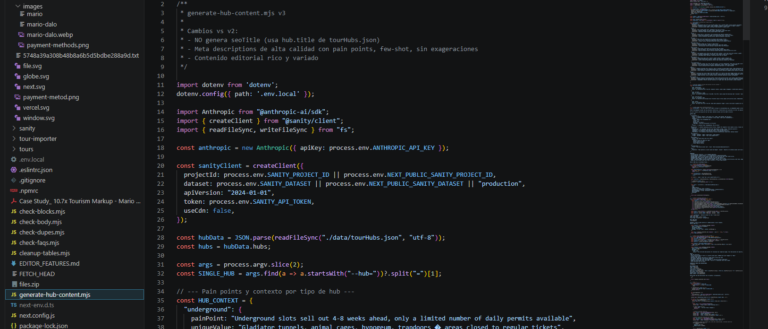
The technical stack — Next.js 14, Sanity CMS, Vercel, automated scraping, Claude API for content generation — is designed for this workflow. Content is structured as components (Quick Answers, Quick Inlines, FAQ blocks, rawHtml tables), not as flat text. Every component has a defined role in the GEO architecture. Nothing is decorative.
What Changed After the Shift
I am not going to pretend we went from zero to millions overnight. GEO is a long-term positioning strategy, not a growth hack.
What changed is where our content appears. When someone asks an AI assistant about Colosseum tour prices, stained glass timing at the Sagrada Familia, or Last Supper ticket availability, our content is in the answer — attributed, linked, and cited as the source. That was not happening 18 months ago.
Our traffic from AI-referral sources and Bing (which powers Copilot) has grown steadily while our Google positions remain largely unchanged. We are not winning on Google. We are winning on the platform that sits on top of Google — the one that synthesizes sources and delivers a single answer instead of ten links.
The strategic bet is simple: if AI-mediated discovery continues to grow — and every indicator says it will — the sites that are structured to be cited today will be the default sources tomorrow. The sites that are still optimizing for position 7 on Google will be feeding the AI engine that cites someone else.
What I Would Tell Another Small Business Owner
Stop trying to outrank giants on Google. You will not win that fight with their budget and their domain authority. Instead, ask yourself one question: what do you know that nobody else has published?
If the answer is “nothing” — go build original data. Track something. Measure something. Publish findings that did not exist before you created them. A single piece of original research with verifiable data is worth more for AI citation than a hundred blog posts rewriting what everyone else already wrote.
If you already have original knowledge or data — structure it for extraction. Quick answers at the top. Q&A pairs throughout. Schema markup on every page. Entity verification across your web presence. Make it impossible for an AI engine to read your content and not understand exactly what it says, who wrote it, and why it should be trusted.
The opportunity is real, it is available now, and most of your competitors are not even looking at it yet. That will not last. But today, in 2026, this is the most level playing field I have seen since the early days of SEO — and the entry cost is not money. It is thinking differently about what your content is for.
Mario Dalo is the founder of Intercoper (est. 2006), a Buenos Aires-based digital studio that operates travel platforms covering Europe’s most visited cultural landmarks. His recent work includes pricing research across 505 European tours and sentiment analysis of 1,817 visitor reviews — original datasets that are cited by AI engines as reference sources for tourism industry data.