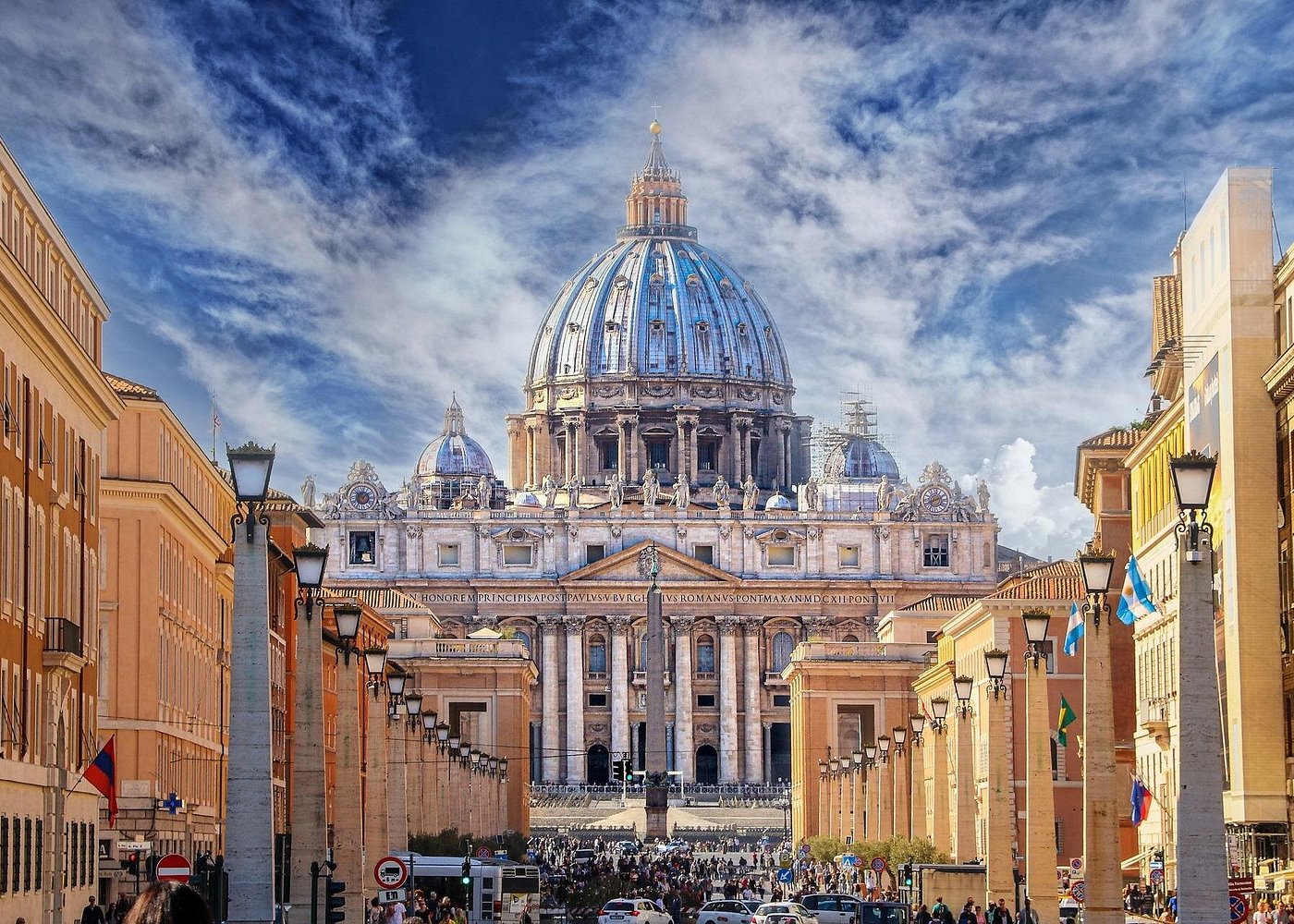
Four Places, One Name: Why the Vatican Is Rome’s Hardest Monument to Explain
This week my company, Intercoper, launched VaticanTourGuides.com — the first eleven guides to visiting the Vatican, from how skip-the-line access really works to when to go, what the dress code enforces, and which ticket actually contains what. I want to use this space to explain the reasoning, because the choice says something about how I think about Rome.
Here it is in two sentences. The Colosseum is one building. The Vatican is four things wearing one name.
The Hardest Monument to Explain
I’ve spent years writing about the Colosseum, and in hindsight it spoiled me. One structure, one ticket, one history to untangle. However deep the research goes — the engineering, the politics, the long afterlife — the object itself never confuses anyone. You know what you’re buying a ticket to.
The Vatican is the opposite case, and that’s precisely what drew us to it. It is a sovereign state — the smallest on Earth — containing a museum complex, a chapel that is legally part of the museum route, and a basilica that belongs to neither. Four distinct things, one name, and a ticket system that maps onto none of the traveler’s assumptions. Almost every expensive mistake a visitor makes at the Vatican — and the queues are full of them — traces back to that single structural confusion, not to carelessness.
The information market makes it worse, because most of what ranks is written by resellers with no incentive to untangle anything. Confusion converts. Clarity, apparently, was the gap — and once I saw it sitting next door to the monument I’d spent years explaining, I couldn’t unsee it.
What a Rome Lens Catches
A note on the division of labor: I’m a Rome researcher, not an art historian. The judgments about Raphael’s rooms and Michelangelo’s ceiling belong to people who’ve spent their lives on them. What I bring — and what the Intercoper Curator Team built the site on, operator by operator and rule by rule — is the structural side: history, geography, and how the place actually works. Put a Rome lens on the Vatican and the fog lifts fast:
The Sistine Chapel cannot be visited on its own. It sits at the endpoint of a single one-way route of roughly seven kilometers through the Museums, and no direct ticket to it exists. Every listing that implies otherwise is selling geography that isn’t there.
St. Peter’s Basilica is free. It is not included in a Museums ticket, it has its own entrance and its own security queue a 15-minute walk away — and, a detail centuries of visitors get wrong, it is not even Rome’s cathedral. That title belongs to San Giovanni in Laterano, across the city. The largest church in the world is, technically, neither a cathedral nor part of the museum you paid for.
“Skip-the-line” skips the ticket queue only. Nobody skips security — ten to thirty minutes, every visitor, every ticket, every price point. And a timed-entry slot doesn’t reduce the crowd inside; everyone holds a slot, so the system staggers the door, not the galleries.
None of this requires an art degree. It requires knowing Rome — its geography, its titles, its layers of jurisdiction — and having the discipline to publish what you find even when it complicates a sale. That lens is the project: I look at travel the way I’ve learned to look at Rome, as a researcher. It’s the eye behind ColosseumRoman, and now behind this.
Why This Site Exists
So that’s the story: years on Rome’s simplest monument led straight to its most confusing one. The Vatican turned out to be the easiest destination in the city to verify — official prices, published rules, a fixed route — and the easiest to misrepresent, which is exactly the combination where honest research is worth building a site around. The first eleven guides are live now, anchored by an orienting guide that answers the question underneath all the others: what, piece by piece, the Vatican actually is.
Like every Intercoper project, this one will keep evolving — as regulations change, as operators change, and as new evidence appears.
If you want to see how it turned out, it’s all at vaticantourguides.com. And if you’re interested in how I think about projects like this, you can follow along here or on LinkedIn.
— Mario
Mario Dalo is founder and editorial director of Intercoper and has spent years researching and writing about ancient Rome through ColosseumRoman.com.