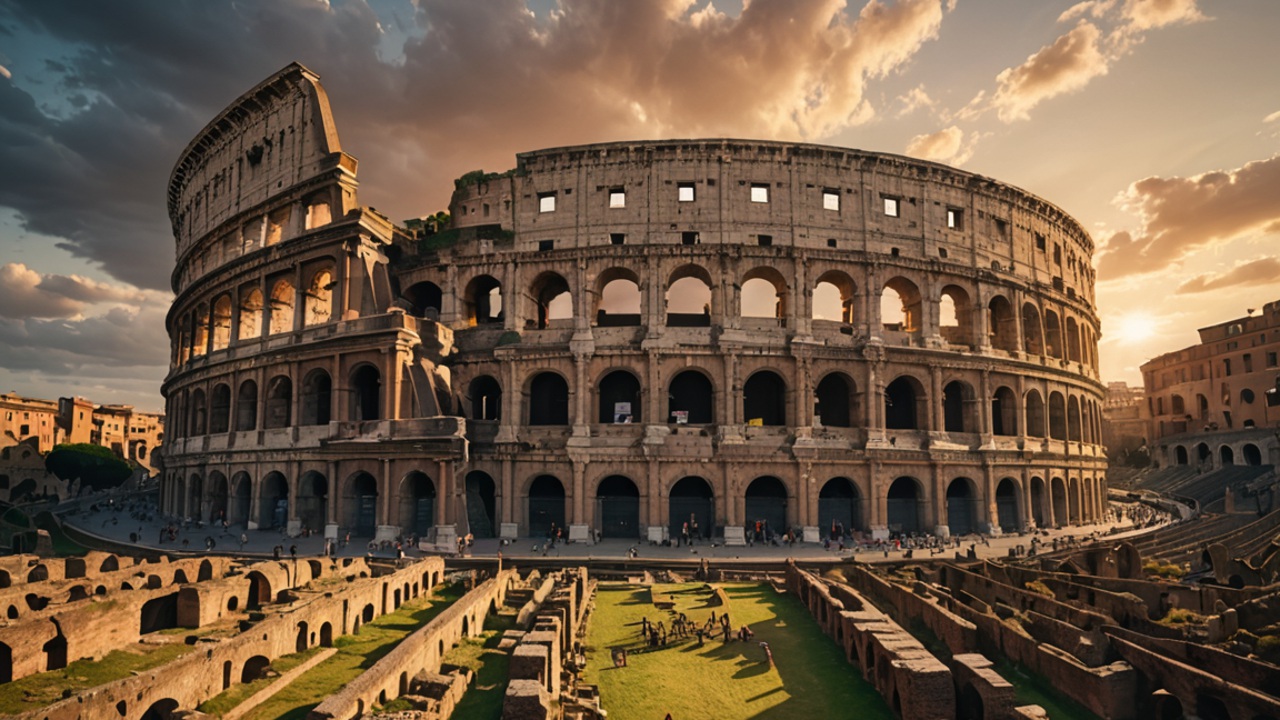
Ancient Rome and the Colosseum: Why This Arena Defines an Entire Civilization
The Colosseum isn’t just Rome’s most famous building. It’s the physical body of its history — the embodiment in stone of everything the Roman Empire stood for: its power, its contradictions, its brilliance, and its downfall.
After years of research into archaeological and historical sources, I’ve come to see that this amphitheater isn’t merely a monument. It’s a summary — a biography of an entire civilization.
Rome Before the Colosseum: Setting the Stage
To understand why the Colosseum matters, we need to understand the Rome that built it. In 72 AD, when construction began, the empire ruled over 40 million people, nearly one-fifth of the world’s population. It spanned five million square kilometers, maintained eighty-five thousand kilometers of roads, and commanded half a million soldiers across thirty legions.
As Mary Beard explains in SPQR: A History of Ancient Rome, the Colosseum rose precisely at the moment when Rome shifted from expansion to preservation — from conquering new worlds to controlling the one it already owned. It marked the empire’s turning point, the beginning of self-reflection after centuries of conquest.
The Political Genius Behind the Arena
The political context was decisive. The Flavian dynasty, led by Vespasian, faced a legitimacy crisis. He had seized power after the chaos of 69 AD, known as the Year of the Four Emperors. Building the Colosseum was more than architecture — it was political theater on a monumental scale.
The choice of location said it all. The amphitheater rose on the site of Nero’s artificial lake, part of his extravagant Domus Aurea — the “Golden House.” Where Nero had built his private paradise, Vespasian built a public arena. The symbolism was unmistakable.
Nero had declared, “I take from Rome for myself.”
Vespasian answered, “I return to the Romans what was stolen from them.”
Excavations by the British School at Rome in 2015 confirmed that Nero’s lake was deliberately filled with concrete — an incredibly costly choice, since they could have built elsewhere. But the symbolism outweighed the expense.
The funding carried another message. In 1813, an inscription was discovered reading “EX MANVBIIS” — “from the spoils of war.” The treasures looted from the Temple of Jerusalem, recorded by Josephus in The Jewish War, financed the Colosseum. Rome’s greatest monument to entertainment was literally built with the spoils of conquest.
How the Colosseum Mirrored Roman Society
The Colosseum was Rome in miniature. Every seating level represented a social class. In the podium, senators sat just three meters from the arena floor, on marble seats engraved with their names. They were allowed to bring their own cushions. Above them sat the equestrian class, along with priests and magistrates. The Vestal Virgins had private box seats. Far higher, in the maenianum summum, the common citizens squeezed onto wooden benches, long since vanished. At the very top stood women, foreigners, and slaves.
Archaeologist Andrew Wallace-Hadrill wrote, “Nowhere else was Roman social stratification so perfectly displayed — and reinforced — in stone.” The Colosseum wasn’t only a place of spectacle; it was a lesson in hierarchy.
Even the spectacles themselves reflected the empire’s identity. Those who died in the arena embodied Rome’s values and ambitions. Criminals (noxii) showcased Roman justice. Prisoners of war demonstrated imperial power. Exotic animals symbolized the reach of empire. And gladiators embodied the ideals of courage and discipline.
A fourth-century catalog lists the creatures once displayed there: elephants, lions, leopards, bears, hippos, rhinos, even giraffes. The arena was a zoological map of empire.
Engineering That Defined Civilization
The Colosseum was as much a triumph of engineering as it was of ideology. The Roman invention of opus caementicium, or concrete, changed the rules of construction forever. The foundation ring measured twelve meters deep and 530 in circumference. Its vaulted corridors distributed the weight of fifty thousand people with extraordinary precision.
According to Lynne Lancaster, author of Concrete Vaulted Construction in Imperial Rome, the structure contained 100,000 cubic meters of travertine, 300 tons of iron clamps, and 200,000 tons of concrete. This wasn’t just architecture — it was materials science two millennia ahead of its time.
What fascinates me most is its efficiency. It had seventy-six numbered entrances, one hundred sixty internal passageways, and could evacuate its entire audience in roughly fifteen minutes. Modern stadiums still study its design; even the Rose Bowl in Pasadena borrowed its crowd-flow model.
Rome solved two thousand years ago the same logistical problems that challenge us today.
The Economics of Entertainment
The famous phrase panem et circenses — “bread and circuses” — coined by Juvenal, often oversimplifies things. Economist Willem Jongman showed that the games consumed five to ten percent of the imperial budget, while free grain distribution supported roughly one-third of Rome’s population. In peaceful years, the cost of feeding and entertaining the capital exceeded military spending.
But this wasn’t waste — it was investment. The emperors understood that food and spectacle were the foundations of stability. Even Marcus Aurelius, who despised the games, attended them because staying away provoked riots.
Behind the scenes, an immense infrastructure kept the machine running. The venatores Caesaris, imperial hunters, captured animals from Britain to Sudan. The journey to Rome could take a year, and most animals died in transit. Thousands worked in gladiator schools — the ludi of Capua, Pompeii, and Rome — where fighters, trainers, doctors, and administrators formed an industry of controlled violence. The physician Galen began his career in one of these schools.
The Colosseum wasn’t just entertainment; it was an economy.
Cultural Impact Across the Empire
The model spread across the known world. Archaeologists have identified over 230 amphitheaters throughout the empire. El Djem in Tunisia could seat thirty-five thousand spectators. Nîmes, in southern France, still hosts concerts today. Pula, in Croatia, remains one of the best preserved.
Historian Alison Futrell, in Blood in the Arena, calls these arenas “culture bombs” — more effective than legions at spreading Roman identity.
Even language absorbed the logic of the arena. Arena (sand) came to mean any space of competition. Gladius gave us “gladiator.” Decimation, once a military punishment performed publicly, entered everyday vocabulary. Law, too, reflected the amphitheater’s influence: damnatio ad bestias (condemnation to beasts), infamia (legal disgrace), and peculium (the property rights of gladiators) all emerged from it. The spectacle shaped the language of power.
The Long Decline: Rome and the Colosseum Together
The Colosseum’s decline mirrored Rome’s own. In 217 AD, lightning struck and fire damaged the upper levels, just as the empire entered the Crisis of the Third Century. In 410, the Visigoths sacked the city, but games still continued, smaller and poorer. In 455, the Vandals looted the bronze fittings. By 476, the last Western emperor fell, and the arena became a cemetery. By 542, during the Plague of Justinian, Rome’s population had dropped below thirty thousand.
By the time the games ended, the city that had built the Colosseum could no longer fill it.
What the Colosseum Reveals About Rome
The Colosseum condenses all of Rome’s paradoxes: an architectural masterpiece dedicated to organized killing; a public space structured by strict hierarchy; a celebration of civilization built on barbarism.
It also reveals the virtues Romans admired most — virtus (courage), pietas (duty), gravitas (dignity), and auctoritas (authority) — as well as their fatal excesses.
Modern estimates suggest 400,000 human deaths and over one million animals perished in its sands. The cost would equal roughly half a billion dollars today, and maintenance soon exceeded construction expenses. Yet somehow, none of that matters. The Colosseum achieved what every empire dreams of: it outlived its own power.
The Eternal Lesson
The Colosseum still stands because Rome built for eternity, even while knowing eternity doesn’t exist. The poet Martial, writing for the inaugural games, claimed it would outlast the pyramids. He was right — though not in the way he meant.
Today, the Colosseum receives more annual visitors than Rome ever had inhabitants. It generates more income for modern Italy than it ever did for ancient Rome. The empire vanished, but its arena endures — transformed from a theater of death into a monument of reflection.
Maybe that’s the most Roman lesson of all: build something strong enough, and it will survive not only you but the entire world that made you. It will keep changing purpose yet still tell your story.
The Colosseum doesn’t just represent ancient Rome — it is ancient Rome, frozen at the height of its power, reminding us that every empire believes it’s eternal, and every empire is wrong. But in being wrong, some of them create something that actually is.
### Academic Sources: – Beard, Mary. *SPQR: A History of Ancient Rome*. Liveright, 2015 – Bomgardner, David. *The Story of the Roman Amphitheatre*. Routledge, 2013 – Futrell, Alison. *Blood in the Arena*. University of Texas Press, 2001 – Hopkins, Keith. *Death and Renewal*. Cambridge University Press, 1983 – Jongman, Willem. *The Economy and Society of Pompeii*. Gieben, 1988 – Lancaster, Lynne. *Concrete Vaulted Construction in Imperial Rome*. Cambridge, 2005 – Wallace-Hadrill, Andrew. *Rome’s Cultural Revolution*. Cambridge, 2008