A Monument Has One Right Answer. A Food Market Has Five Thousand.
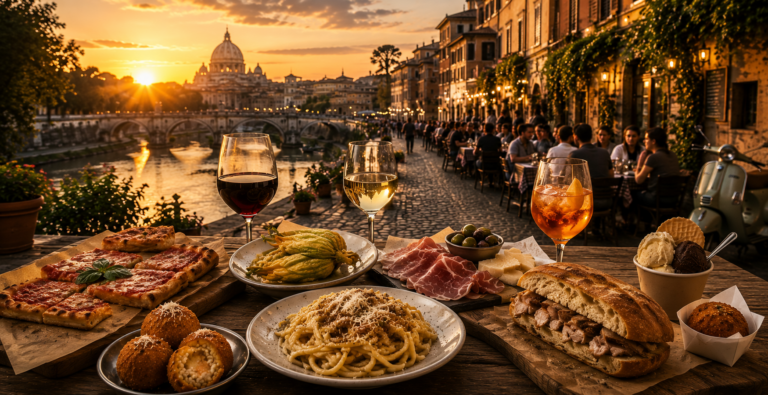
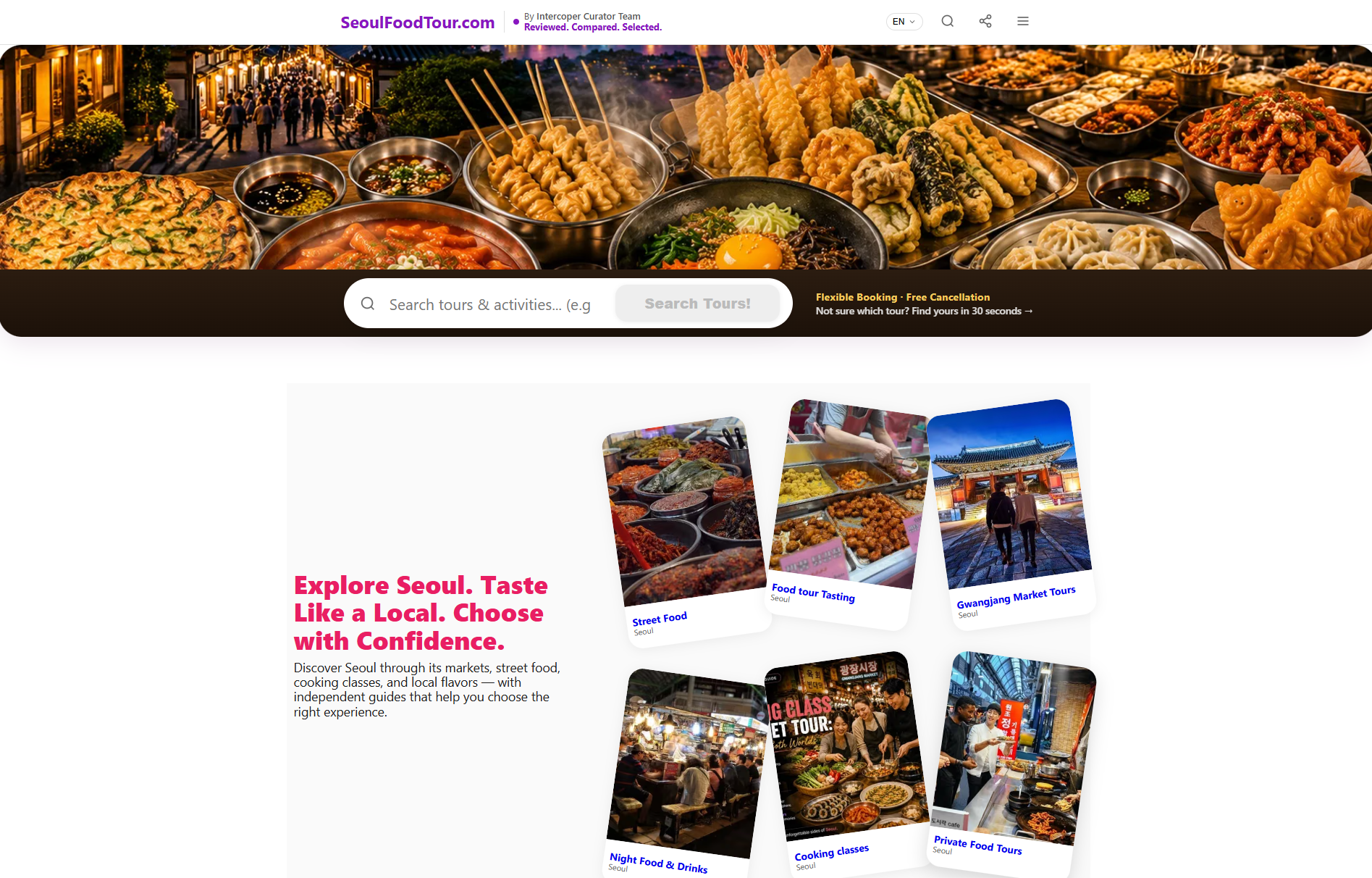
Most of the work I’ve spent the last two decades on has been organized around buildings. A monument is a generous subject for a travel guide, and not for the reason people assume. It isn’t that monuments are simple — the Colosseum is endlessly deep, and I’ve written about it for years without running out of material. It’s that a monument gives you something to check your work against. Our newest guide, SeoulFoodTour.com, is the first our studio has built where that isn’t true.
There is an official ticket price, published by a government body. There are opening hours. There is a fixed route, a defined set of access tiers, a stated dress code. When a reseller claims something untrue, you can prove it’s untrue, because an authority exists and it has a website. The job of a guide, in that world, is largely to find the truth and state it plainly against a lot of noise that would prefer you didn’t.
A food city takes that away entirely. And having watched our team work through Seoul, I think it’s a genuinely harder editorial problem than a monument — not because there’s less information, but because there’s nothing to verify against.
There Is No Ministry of Bindaetteok
Consider what a food guide is actually claiming when it names a “best” anything.
At a monument, “which tour is best” resolves into checkable components: what does it include, what does it cost, does it skip the queue, is the guide licensed. You can answer it. At a market, “which stall makes the best mung bean pancake” resolves into — what, exactly? There is no authority that certifies it. There is no published price. The vendor who was extraordinary in 2019 may have handed the griddle to a nephew. The queue may be long because the food is superb, or because a Netflix crew filmed there in 2015 and the algorithm never forgot.
This is not a small gap. It’s the difference between reporting a fact and manufacturing one. And the temptation in food writing is enormous, because the format rewards confidence: readers want a name, an address, a verdict. A page that says “this stall, this dish, trust me” outperforms a page that says “here is how to tell a good stall from a tourist trap.” The first is more satisfying. The second is more often true.
What Can Actually Be Verified
The useful move, I think, is to stop trying to verify the unverifiable and get rigorous about the large amount that can be checked. It turns out to be more than you’d expect, and it’s the part that actually changes a traveler’s day.
You can verify structure: that Gwangjang opened in 1905, that its fabric stalls close around six while the food alley runs to eleven-thirty, that Jongno 5-ga Exit 8 puts you at Gate 2 and Gate 2 puts you in the food corridor. You can verify economics: that a full market meal costs around $20–30 while a guided tour costs several times that, which reframes the entire question of what a tour is for. You can verify composition — that roughly 95% of stalls use fish sauce or meat powder, that anchovy stock is in nearly every broth, that the beloved bean pancake is usually fried in lard. That last set of facts is worth more to a vegetarian traveler than any number of stall recommendations, and almost nobody publishes it.
And you can verify claims about claims: that “small group” is not a regulated term, that a platform’s advertised cancellation policy is overridden by the operator’s, that the most touristed street-food district is also the most overpriced. None of this requires knowing which pancake is best. All of it changes what a traveler does.
The Discipline of Not Knowing
The harder discipline is the negative one — being willing to publish the shape of your own uncertainty.
Prices are the clearest case. A monument’s ticket is a number you can state. A food tour’s price moves with operator, season, group size, and demand; a stall’s price moves faster. So our team publishes ranges and points to the booking platform for the live figure. A precise number would look more authoritative and be less true, and I’d rather the site be trusted in a year than impressive today.
The same logic governs reviews. We maintain a large verified review corpus for the Colosseum — thousands of items, gathered and analyzed deliberately — and we cite it there because it exists. We have nothing equivalent for Seoul, so the Seoul guides quote no reviews and claim no aggregate findings. It would take an afternoon to add plausible-looking quotes and a methodology page. It would also be a lie, and the thing about manufactured authority is that it works right up until the moment someone checks.
There’s a version of this that sounds like false modesty. It isn’t. Saying “here is what we know, here is what we don’t, here is who to ask” is a stronger claim than pretending to know everything, because it tells the reader exactly how much weight each sentence will bear.
Why the Absence of Structure Is the Point
None of this is a complaint about food cities. It’s an argument that they demand a different kind of guide.
A monument punishes the underinformed traveler with a wrong queue or a wasted ticket. A food city punishes them more quietly: they eat, they enjoy it, they never learn what they missed. Nobody comes home from Seoul saying they had a bad time. They come home having spent four days eating at the third-best stalls at tourist prices, which is a fine holiday and a fraction of what was available.
Closing that gap doesn’t require telling anyone which pancake to eat. It requires giving them the structure the city doesn’t announce: which market is which, what things actually cost, what the language barrier really hides, when the guided tour earns its price and when it plainly doesn’t. Get that right and the traveler makes their own discoveries — which, in a city with five thousand stalls, was always going to be the better outcome than following someone else’s list.
Mario Dalo is the founder of Intercoper, a Buenos Aires digital studio that has built and operated independent, research-driven travel guides since 2006, including ColosseumRoman.com, VaticanTourGuides.com, and SeoulFoodTour.com. He serves as editorial director for the Intercoper Curator Team.