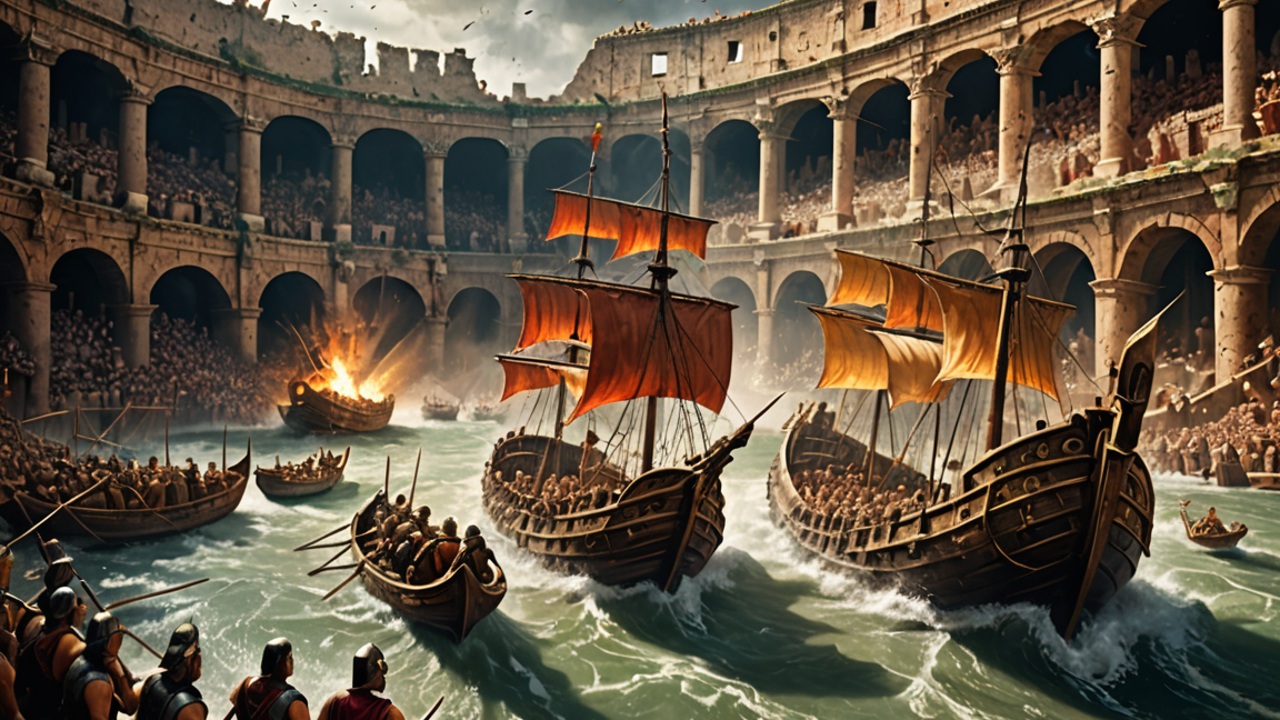
The Colosseum’s Bloody Water Battles: Fact or Myth (Naumachia)?
The Colosseum’s Naval Battles
Did the Romans really flood the Colosseum for naval battles? It’s one of those questions that have divided historians for centuries. Some call it impossible, others swear it happened. After diving deep into archaeological evidence and ancient sources, here’s what I’ve learned about the naumachia inside the Colosseum — and why the truth is far more complex than it seems.
The Claim That Sounds Impossible
I often ask visitors to imagine it. Fifty thousand Romans watching full-size ships battling inside the Colosseum, which has somehow been transformed into a lake. Condemned criminals dressed as Greeks and Persians fight to the death as water swirls where gladiators normally stand. It sounds like pure Hollywood. And yet, several ancient writers insist it really happened.
What Ancient Writers Actually Said
Two sources describe the opening spectacle of 80 AD in detail.
Cassius Dio, writing about a century and a half later, claimed: “Titus suddenly filled this same theatre with water and brought in horses and bulls and other domesticated animals that had been taught to behave in the liquid element just as on land. He also brought in people on ships, who engaged in a sea-fight there.”
Meanwhile, the poet Martial, who actually witnessed the games, wrote: “If you are arriving late from distant lands, spectator, for whom this sacred day’s entertainment is new… don’t let the naval battle with its ships deceive you, and the waters that resemble seas: here but lately was dry land.”
That’s an eyewitness describing an arena that turned into an ocean — not bad for fiction.
The Engineering Evidence Says “Maybe”
When I started looking at how it could work, I found Rabun Taylor’s hydraulic study. He calculated that flooding the Colosseum would have required at least five million gallons of water, taking four to seven hours to fill and two to three hours to drain. The depth could reach about five feet — barely enough to float small boats.
Roman engineers did leave behind evidence of water pipes and drainage channels, some with a combined flow of roughly 1,000 liters per second. Theoretically possible, but only just.
The main problem is the hypogeum, the underground network of tunnels and lifts added by Emperor Domitian around 81–96 AD. Once that basement existed, flooding became impossible. You can’t have both a stage floor and a lake. That means any naumachia must have taken place in a narrow window — between 80 and roughly 85 AD.
The Archaeological Smoking Guns
Several findings make the case intriguing.
Archaeological surveys by Lancaster and Ulrich (2014) revealed enormous drains beneath the arena, some two meters in diameter, and traces of waterproof concrete — the kind used in Roman aqueducts, not theaters. Coins from Titus’s reign show the amphitheater with a flat arena floor and no sign of the hypogeum. It suggests that the underground levels hadn’t yet been built.
Even the lower arena walls preserve remnants of opus signinum, a pinkish hydraulic plaster designed to resist water. Why waterproof stone unless you planned to flood it?
And yet, there are problems too. A five-foot-deep pool wouldn’t accommodate real warships; their hulls would scrape the bottom. A structural study by the University of Bath estimated that the water’s total weight — about twenty thousand tons — would strain the foundations far beyond their design. Add the logistics of bringing ships through the city and removing bodies afterward, and it starts to sound like a logistical nightmare rather than a festival.
The “Other” Naumachia Solution
The Romans actually had purpose-built arenas for naval battles.
Augustus’s Naumachia, inaugurated in 2 BC, measured over 1,800 by 1,200 feet and was fed by its own aqueduct. It hosted thirty full-sized ships and three thousand fighters. Later, Claudius staged another on Lake Fucine, using a hundred ships and nineteen thousand combatants while half a million spectators watched from the shore.
Compared to those, flooding the Colosseum would be like trying to reenact D-Day in a swimming pool. So maybe the “sea fights” described by ancient authors were smaller theatrical recreations rather than full naval wars.
The Compromise Theory
That’s where Professor Katherine Coleman’s study comes in. Published in Journal of Roman Studies, it proposes a middle ground: the Colosseum hosted “theatrical naumachia” — staged performances with shallow water, small boats, and a limited number of participants.
In other words, it wasn’t The Battle of Actium — it was closer to choreographed aquatic theater, perhaps a cross between gladiatorial combat and synchronized swimming. For the Romans, who loved technical spectacle as much as blood, that was more than enough.
The Venice Test Case
Centuries later, in 1574, Venice tried to recreate the Roman wonder for King Henry III of France. They flooded an arena for a mock naval battle. It took three weeks of preparation, two hundred workers, and ended with a partial collapse due to water pressure. The venue was never used again. If Renaissance engineers struggled with better pumps, it’s hard to imagine ancient Romans pulling it off routinely.
What Probably Really Happened
Piecing it together, here’s the most plausible scenario I’ve found.
In 80 AD, during the opening games of the Colosseum, the arena was indeed flooded — at least once. The water was shallow, maybe a meter deep, enough for small craft carrying costumed prisoners. Perhaps ten or twenty boats fought in a single-day show. Within a few years, as the hypogeum was built, flooding stopped entirely. Later emperors held their naval spectacles elsewhere, while the Colosseum’s legend grew far beyond reality.
Why This Debate Still Matters
What fascinates me most is what the naumachia debate reveals about how we read history. Ancient sources weren’t lying — they just exaggerated. Martial says “ships,” but doesn’t tell us how many. Archaeology gives clues, but not certainty. And modern imaginations fill the gaps with movie-scale drama.
Sometimes the truth sits quietly in between — the Romans did do it, but not the way we picture it.
The Modern Investigation
In 2014, Italian engineers used ground-penetrating radar to map the Colosseum’s foundations. They discovered traces of sealed channels once connected to aqueducts, evidence of multiple arena reconstructions, and signs of ancient water damage deep below the hypogeum. There are even hints of small basins or pools beneath the floor — perhaps remnants of those brief aquatic experiments.
The research is ongoing. Each year, the data grows, the models improve, and the line between myth and reality keeps shifting.
And that, to me, is the most Roman thing of all: they probably flooded the Colosseum simply because they could, stopped when it became impractical, and left us arguing about it two thousand years later.
Sources & Evidence
Taylor, Rabun. “Roman Spectacle Venues.” Classical Antiquity, 2021
Coleman, K.M. “Launching into History: Aquatic Displays.” Journal of Roman Studies, 1993
Italian National Research Council GPR Survey. Nature Scientific Reports, 2018
Cassius Dio, Roman History Book 66
Martial, Liber Spectaculorum (Book of Spectacles)
Suetonius, Life of Titus